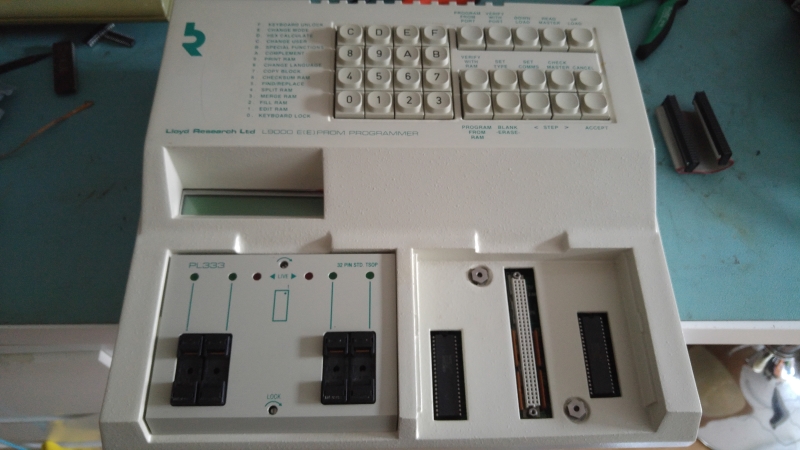
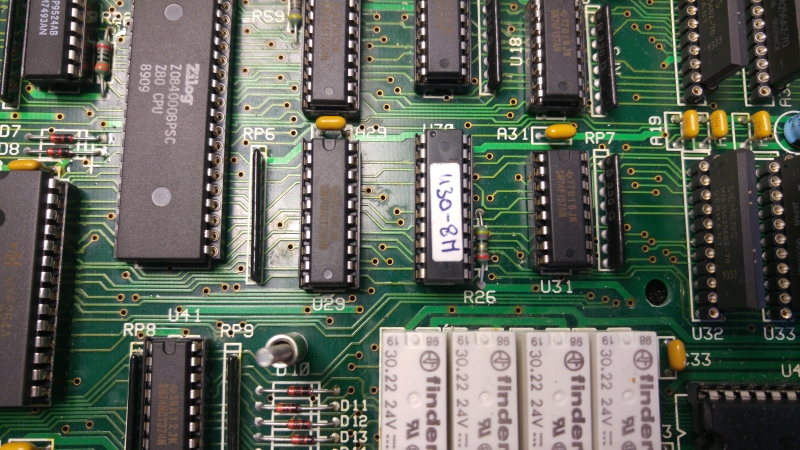
Today I got an interesting programmer unit.
Its made by a UK company called Lloyd Research and doesnt seem to be active anymore although their website is still up and running.
There is very little about these online, only one website came up in my searches with any kind of information and thats Baddinsbits.
I contacted the owner of this site and he kindly scanned in the manual for this programmer and sent it to me (manual can now be found in the downloads).
I dumped my firmware which seems to be one of the later versions, possibly from 2004.
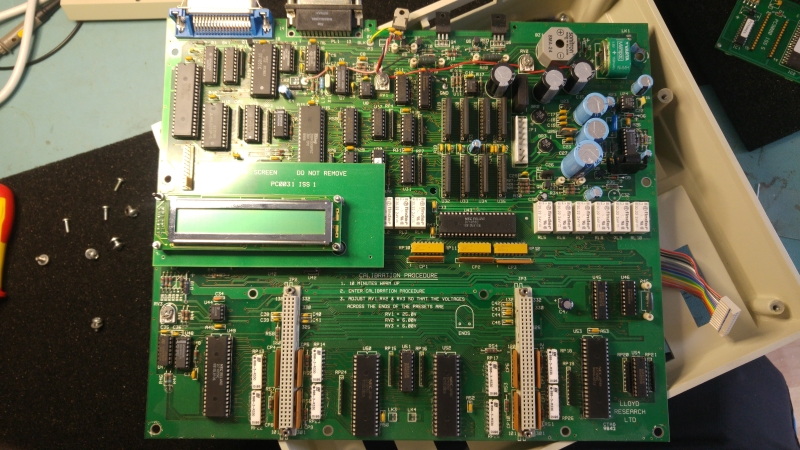
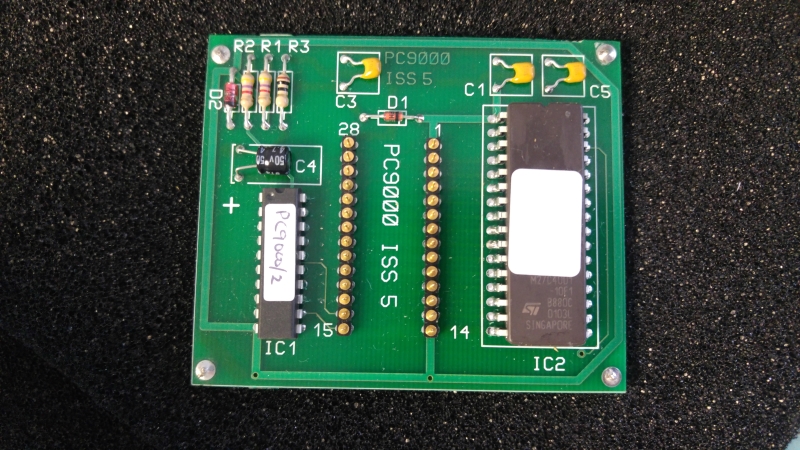
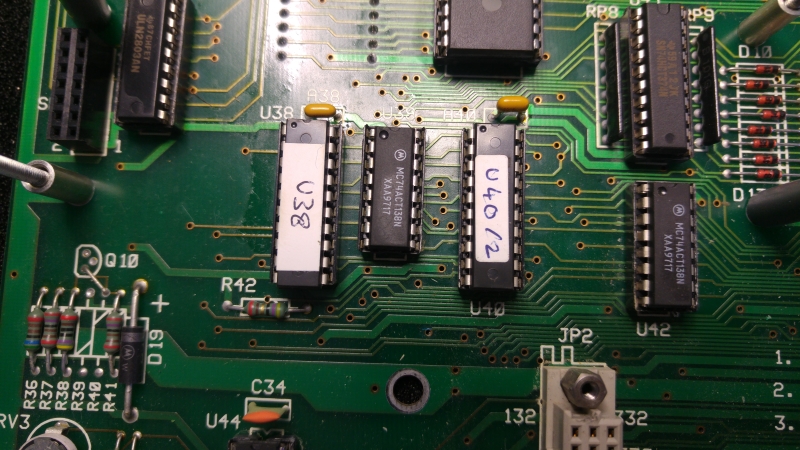
I also went ahead and dumped the PAL’s from inside. There is one located on the EPROM PCB, two located under the LCD screen and one located next to the RAM. The one next to the RAM was locked which makes sense as I believe RAM upgrades were sold as optional extras. Anyway I managed to glitch this PALCE device and read out its contents. This is from the 8Mbit version.
If anyone has any other files, information or dumps they can give me please get in touch.
Big thanks to Baddin for the manual and the conversation.
The hardware of this matches Part II but it has the multigame add-on fitted.
Not worked on a Space Invaders board before and needed to make up a loom so I could properly test.
The owner says the ship is constantly pulling to the left and there is a sound effect playing over and over all the time.
On powering up I did indeed find these problems. Look at the video, the in game play shows me moving the ship to the right but when I release the controls it moves back far left on its own.
You can also hear the constant tone repeating over and over.
First of all I went looking for the control issue.
The schematics are available however they aren’t too great in places. Fortunately they were good enough to save me a lot of time.
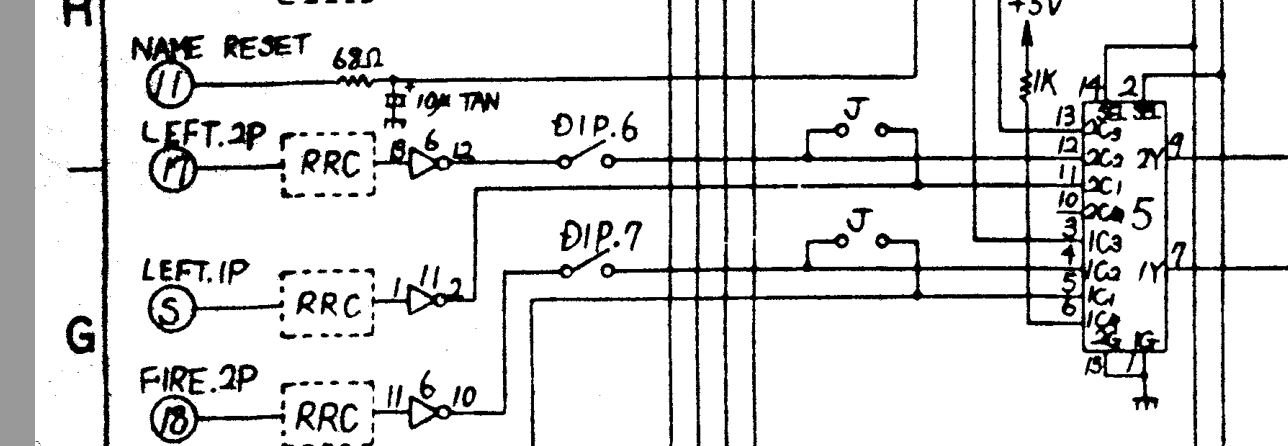
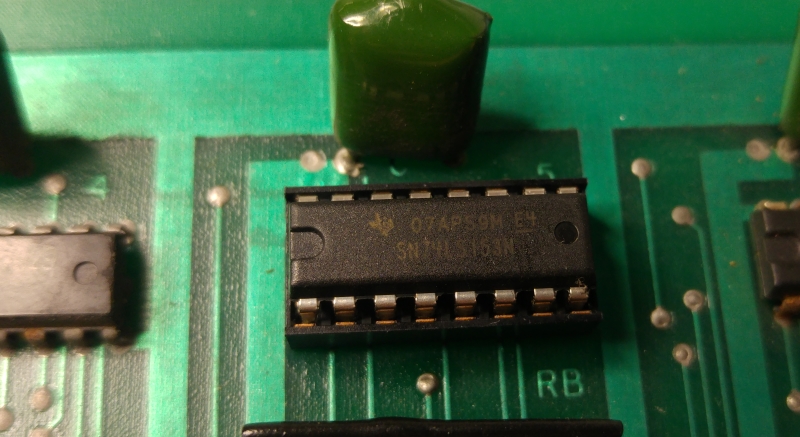
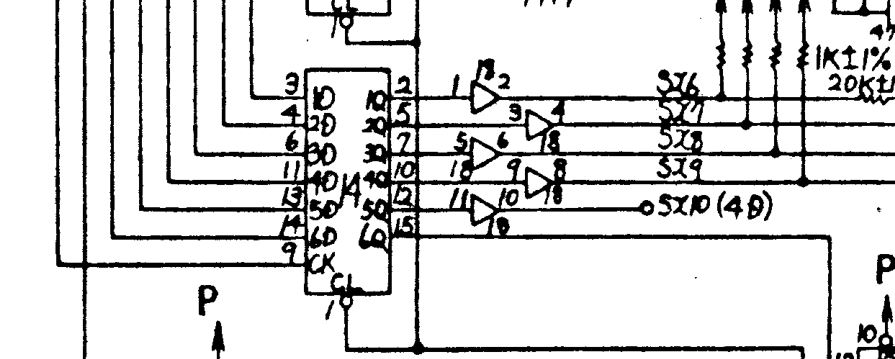
Here you can see where the player 1 left comes in. It goes through an inverting buffer and into a 74153 chip at location 5. The output on pin 9 is the one we are concerned with
From my logic probe I could see that this output is stuck when it should be active. Testing this out of circuit confirmed it.
This fixed the control issue .
Now on to the sound fault.
Space Invaders hardware made this quite easy as each sound effect has its own volume control. By turning the pots down I could pinpoint which sound was stuck on and work back from there.
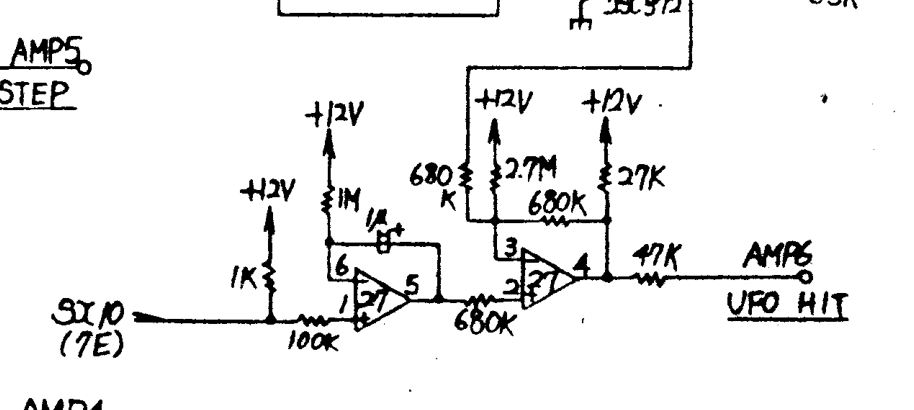
VR7 was the pot associated with this sound and according to the manual this is the sound of the “UFO HIT”.
Looking at the schematics again and working backwards we can see it goes back to buffer chip 7417 at location 18 and before that it comes from a 74174 at location 14.
The outputs from the 74174 looked good but all the outputs from the 7417 buffer were stuck HIGH.
I removed the chip and once again it failed when testing out of circuit but now I had problem. I dont have any 7417 chips and I no longer have scrap PCB’s lying around.
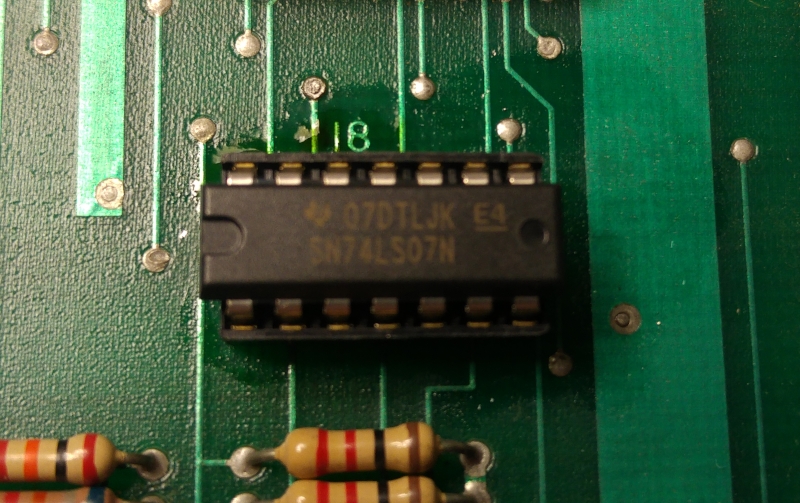
The sadness was short lived as a quick google search revealed a 74LS07 chip can be used as a replacement and the difference between the two is the 7407 is rated for 30v where the 7417 is rated for 15v.
Anyway, replacing this with a 74LS07 worked and the sounds are all OK.
The video shows the controls now working and the lack of annoying sound. I did actually test the UFO HIT sound in game and it was working fine.
PAL UpdatesComments Off on Fluke 9100 SCSI PAL added & Operation Thunderbolt dumps tested
Aug222016
Today I successfully converted the Operation Thunderbolt PAL dumps to GAL format and tested all of them. This is now a complete set.
Andrew96 also dumped, tested and submitted the PAL dump from the Fluke 9100 SCSI card. Big thanks to Andrew for this.
Received this original Nichibutsu Terra Cresta PCB for a repair:
Board had severe graphical issues, backgounds were all messed up and moving, sprites absent:
The first thing I noticed after my visual inspection was that both boards were fully populated with Fujitsu TTLs therefore I was pretty sure all the faults were due them.To troubleshoot them I used my HP10529A logic comparator for TTLs up 16 pin and a logic probe for 20 pin ones.The backgrounds data are stored in two 27256 EPROMs @15F and 17F on CPU board so I went to probe around and I found a 74LS273 @18E with stuck outputs:
This was confirmed also by a logic analyzing of the device:
Once desoldered the device failed when tested out-of-circuit:
I got improvements, now backgorunds were almost formed but still scrambled and sprites visible although not perfect:
With my HP10529A I found a 74LS157 with floating outputs @17D on CPU board:
Chip failed the out-of-circuit test:
Backgrounds were now 100% restored but sprites missing lines with some garbage on screen :
At this point I focused on video board since all objects circuitry lies there :
Probing around the sprites EPROMs, I found a 74LS367 @1F with bad outputs:
and a 7LS257 @3C (involved in sprites RAM data bus) with stuck outputs, also this failed its test:
Now sprites were perfect but doing some comparison with MAME I realized that characters were totally missing!
Found a 74LS257 @14G with missing input pin 15 (/OE ) in the area of the character ROM:
I traced it back to an output of a 74LS367@20B on CPU board:
Logic analyzing confirmed its outputs were floating and chip failed once tested out-of-circuit:
Characters were back:
I was archiving this repair when, during my test, I experienced some sound issues, sometimes audio was distorted:
This board uses an YM3526 OPL IC paired with an YM3014 DAC although chips are marked with Nichibutsu part name (‘TC 148509’ and ‘TC 1409’) :
Probing pin 2 (the analog output connected to the OP-AMP) of the ‘TC 1409’ revealed a weak signal:
I replaced it with a YM3014 :
This gave good sound back.Board 100% fixed and evil Fujitsu once again defeated.
PAL UpdatesComments Off on Some untested PAL dumps added
Aug192016
Today we have some PAL dumps from not working boards (Funworld, Jolly Card and Jolly Joker), hence they are all untested.They have been dumped by Team Europe using an adapter (designed by Charles MacDonald) able to read the PLD as a 27C020 EPROM, therefore they provided binary dumps which I took care to analyze and reverse into GAL16V8.Thanks to Team Europe for their contribution.