New contributor time again. This time cpsystem3 has joined us.
Welcome!
Apr 152015

New contributor time again. This time cpsystem3 has joined us.
Welcome!
16/03/2018
Minor fix.
Text references 8C instead of 19E when sub-cpu EPROM fails checksum.
Fixed output to reference 19E.
11/04/2015
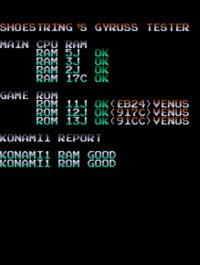
Support for Venus set added.
Bug fix – Addresses issue when 13J reports bad and prints NG twice, CPU gets lost and crashes game.
10/04/2015
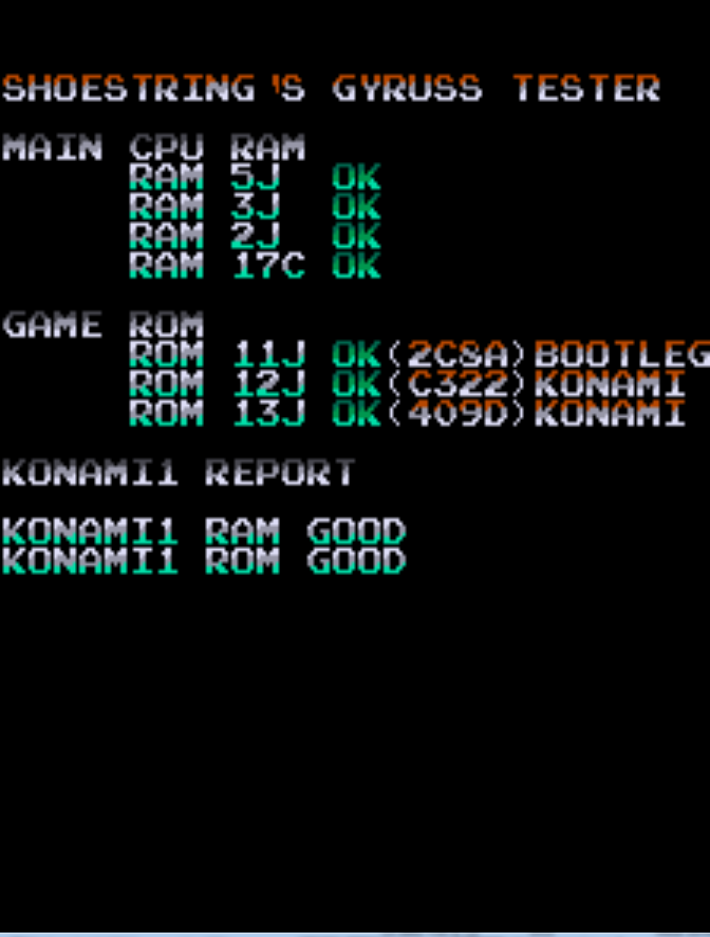
Support added for bootleg ROM from the gyrussb set.
Single ROM labelled “1” at 11J. Other two ROMs are from the original Konami set.
See downloads for update.
4/4/2015
Bug: Sometimes index starts at 5 or some other random value when entering SFX TEST for the first time after power-up. The sound index is written/read to/from $9000 for cycling through 100 possible combinations.
Fix: Cleared this part of RAM before using it.
28/3/2015
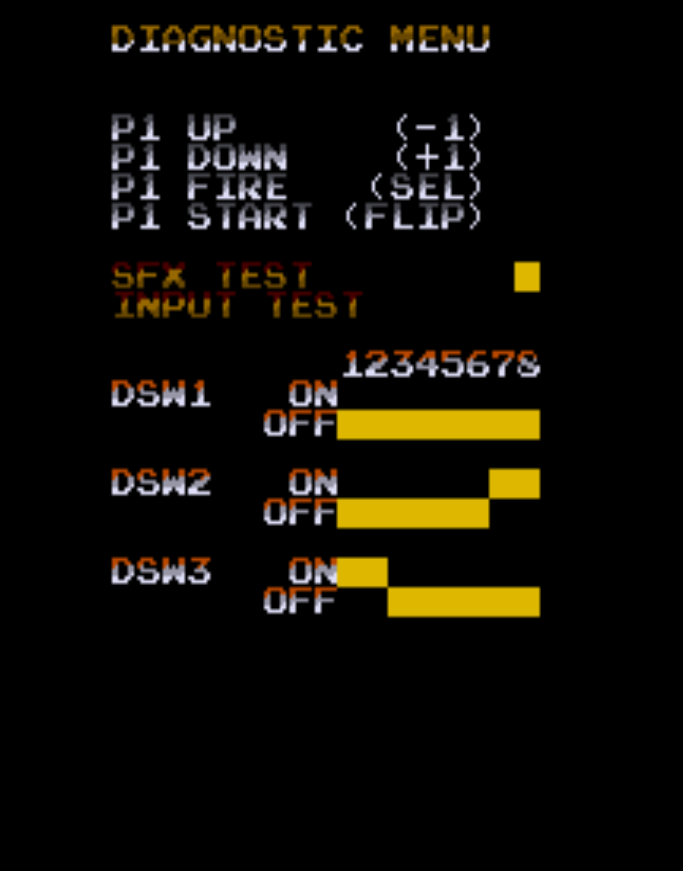
1. Added flip to test cocktail mode.
2. Summary added to menu screen of dip switch settings
3. Added routines to check the stack ram @ 3J before moving on to further tests. Since the stack is used to perform further HW testing, execution is now suspended if a stack error is detected with an associated error message.
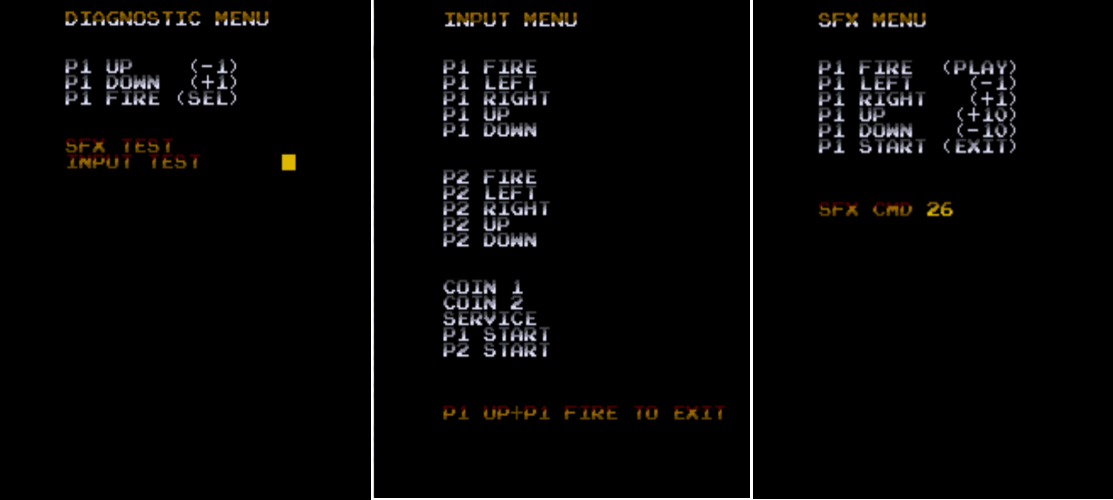
4. Diagnostic mode added via dip 2 of DSW3. Allows for testing sounds and inputs.
See downloads for update.
26/03/2015
Minor update.
1. Re-wrote much of the code up until where it verifies the work RAM. Purged CPU instructions that rely on the reliability of the the stack which is set to 0x9800 in the work RAM. ( work RAM is verified as good first before using the stack )
2. Background is set to yellow instead of black if video RAM at 5J is bad. This is to assist in troubleshooting. A sound effect is also played when 5J is detected as bad to add redundancy in case none of the light brown colour shows up on the screen.
3. Fixed the boot to As issue. When 13J is pulled it now reports as bad. This was fixed by addressing the issues resolved in 1.
Bugs
* When GY5 is pulled “KONAMI1 NOT RESPONDING” is displayed with no additional information. An additional message should be added to point out a problem with either the CPU, ROM or RAM on the 6809 side. The above is also reproduced by removing the 42 pin custom CPU. Random sprites are also present.
To do: Fix above mentioned bugs.
See downloads for the latest version
03/2015
Gyruss Test & Diagnostics ROM.
The 27C64 EPROM installs at 14J on the CPU board. It performs a series of RAM & ROM tests to identify any problems & will attempt to boot the game once tests are completed regardless of failures found. The EPROM can stay in the socket and it does not interfere with the game in any way once the game starts.
Use at your own risk if you’re using the highscore kit, this will delete your scores as it will performs a series of writes to the NVRAM.
I would like to thank cmonkey & DarrenF on KLOV for providing valuable information & help regarding the hardware. I would also like to thank the MAME team for their great work on the emulator and the Gyruss driver, without these cool debugging features in MAME development of this ROM would not have been possible.
cmonkey needed a replacement 315-5224 chip for his Outrun board.
We have a bunch of PLD dumps from an Outrun board but they are untested and are from an unknown source.
The original 315-5224 is a PLS153 and cmonkey needed it in a GAL16V8 in order to replace it.
The equations themselves aren’t too complex and would fit nicely into a GAL16V8 as the extra IO pins on a PLS153 are actually configured as inputs which makes it pin compatible.
Equations:

PIN 13: /ROM_CE = /MREQ & RFSH & RAM_CS & DACS

PIN 14: /RAM_CS = A11 & A12 & A13 & A14 & A15 & /MREQ & RFSH

PIN 15: /YM_CS = /A6 & /A7 & /IOREQ & M1

PIN 16: /DACS = /A11 & A12 & A13 & A14 & A15 & /MREQ & RFSH

PIN 19: /ZCS = A6 & /A7 & /IOREQ & RFSH
The problem came with needing to use the feedback from pin 16 in order for it to work.
When compiling equations for a GAL16V8 you need to specify what mode you want to use it in. There are three modes a GAL can be used in.
1. Simple
2. Complex
3. Registered
The PLS153 cannot be used as a registered device so we cannot use this mode.
‘Complex’ cannot be used as we need to use pin 12 as an input and pin 12 does not provide any feedback in this mode.
‘Simple’ mode is what we need to use but in this mode pins 15 and 16 cannot provide feedback which is exactly what we are wanting.
Looking at the equations and the schematics we can see that pins 17 and 18 are actually unused. These pins can also provide feedback in ‘simple’ mode.
The workaround for a GAL16V8 is to copy the equations for /o16 and add them to /017 then change the equations for /o13 to use feedback from o17 instead of o16, like this:
Equations:

PIN 13: /ROM_CE = /MREQ & RFSH & RAM_CS & DACS2

PIN 14: /RAM_CS = A11 & A12 & A13 & A14 & A15 & /MREQ & RFSH

PIN 15: /YM_CS = /A6 & /A7 & /IOREQ & M1

PIN 16: /DACS1 = /A11 & A12 & A13 & A14 & A15 & /MREQ & RFSH

PIN 17: /DACS2 = /A11 & A12 & A13 & A14 & A15 & /MREQ & RFSH

PIN 19: /ZCS = A6 & /A7 & /IOREQ & RFSH
cmonkey has confirmed this works on his Outrun PCB.
Although this worked well I was not happy with the workaround. The resolution turned out to be simple.
If I took the newly programmed GAL chip and re-dumped it using Charles MacDonald’s hardware I got a list of valid equations that did not rely on the use of feedback at all.
Since the equations were few, it had no problems in fitting into a GAL16V8 and so I ended up with something that left those two unused pins free which is good because cmonkey has a use in mind for them.
Back in January there was a discussion going on over on the Jamma+ forums regarding the D77-14 and D77-15 PAL dumps.
After a lot of help from various people and testing by myself here is the conclusion I have come to regarding this issue.
D77-14 is used when the main CPU ROM’s are 27c2001 (0x40000).
D77-15 is used when the main CPU ROM’s are 27c4001 (0x80000).
On a 27c2001 EPROM, pin 31 is the programming pin. It is active low so once the chip is programmed we want to keep this held high when in use. That’s exactly what the D77-14 PAL is doing. Pin 19 of this PAL is fixed HIGH and is connected to pin 31 of the 27c2001 EPROM.
On a 27c4001 EPROM, pin 31 not the programming pin but it is the upper most address bit and that’s why with a D77-15 pin 19 is able to toggle which allows for double sized EPROM’s to be used.
This is where the confusion comes in.
On many converted boards out there in the wild (and there is a lot of them) we have found there to be D77-14 stamped PAL chips with the same code as what we have found in D77-15 PAL chips and vice versa. Assuming the PAL chips themselves are the original ones from Taito (and I have no reason to see why they wouldn’t be) then my theory is, as they are all PALCE16V8 chips, which are reprogrammable, they have simply been reprogrammed by the bootlegger/converter to use whatever version they needed. This would keep it looking that little bit more authentic and also cuts down on the cost of buying a GAL16V8.
If you check in the MAME source too, every game that has program ROM’s of size 0x40000 uses the D77-14 PAL and every game that has program ROM’s of size 0x80000 uses a D77-15 PAL.
Hopefully that will clear up a bit of the confusion surrounding this.
Shoestring has joined the site so welcome to him.
He has also added his Gyruss test ROM which can be found in the downloads section.
Once again, welcome to Shoestring