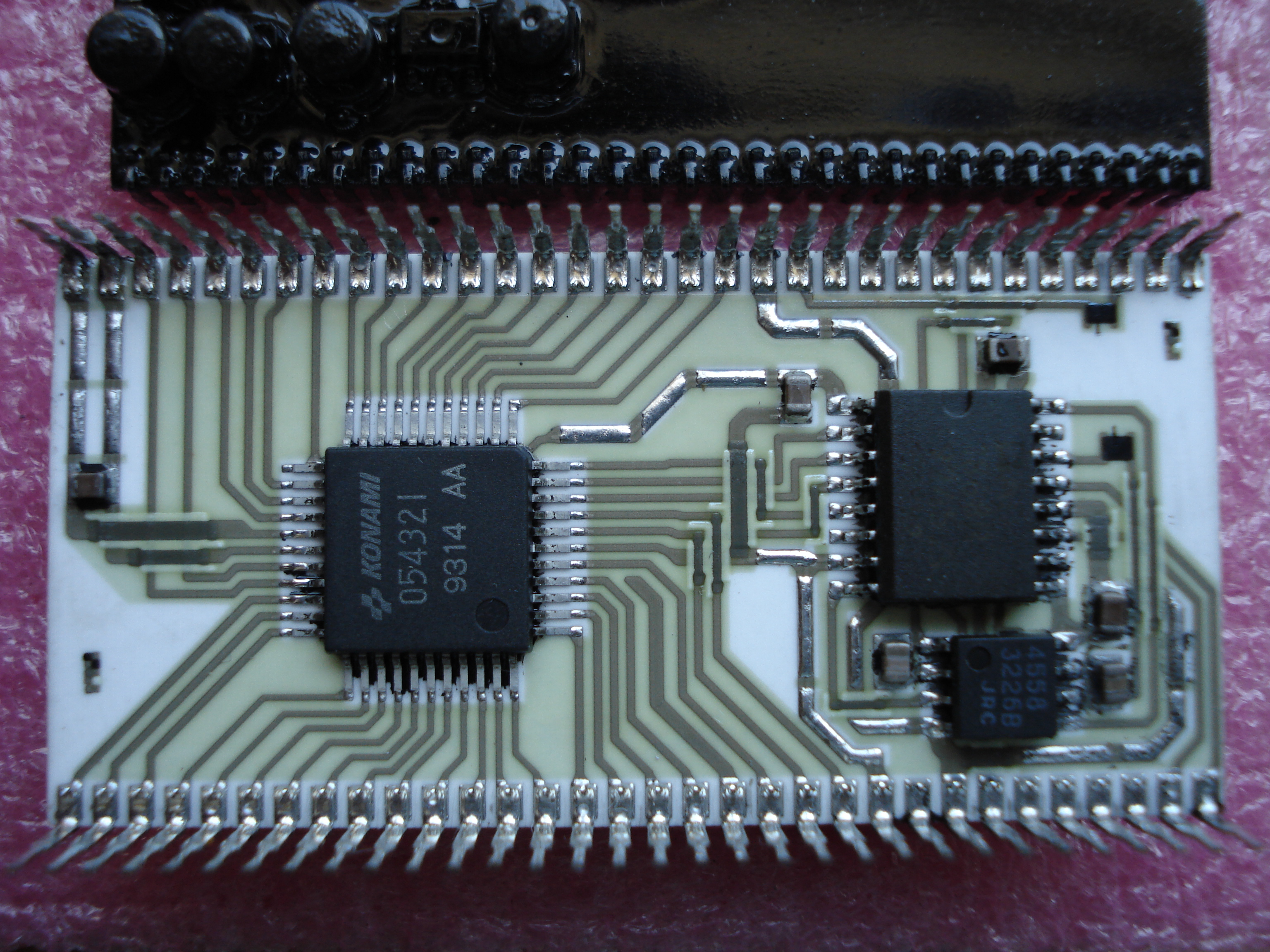
Logic Probe testing

 General  Comments Off on Logic Probe testing
Sep 112015
 

This is something I’ve wanted to do for a while but never got around to.
The following is a mix of my personal thoughts and findings. I realise others will have the same equipment and the operation of these will likely differ.
This post is in no way a “What to buy” guide. It is meant to show how three different probes work at different voltage levels.

I’ve got three logic probes but only ever use one of them as I really like it but is it giving me the most accurate reading?
Lets take a look

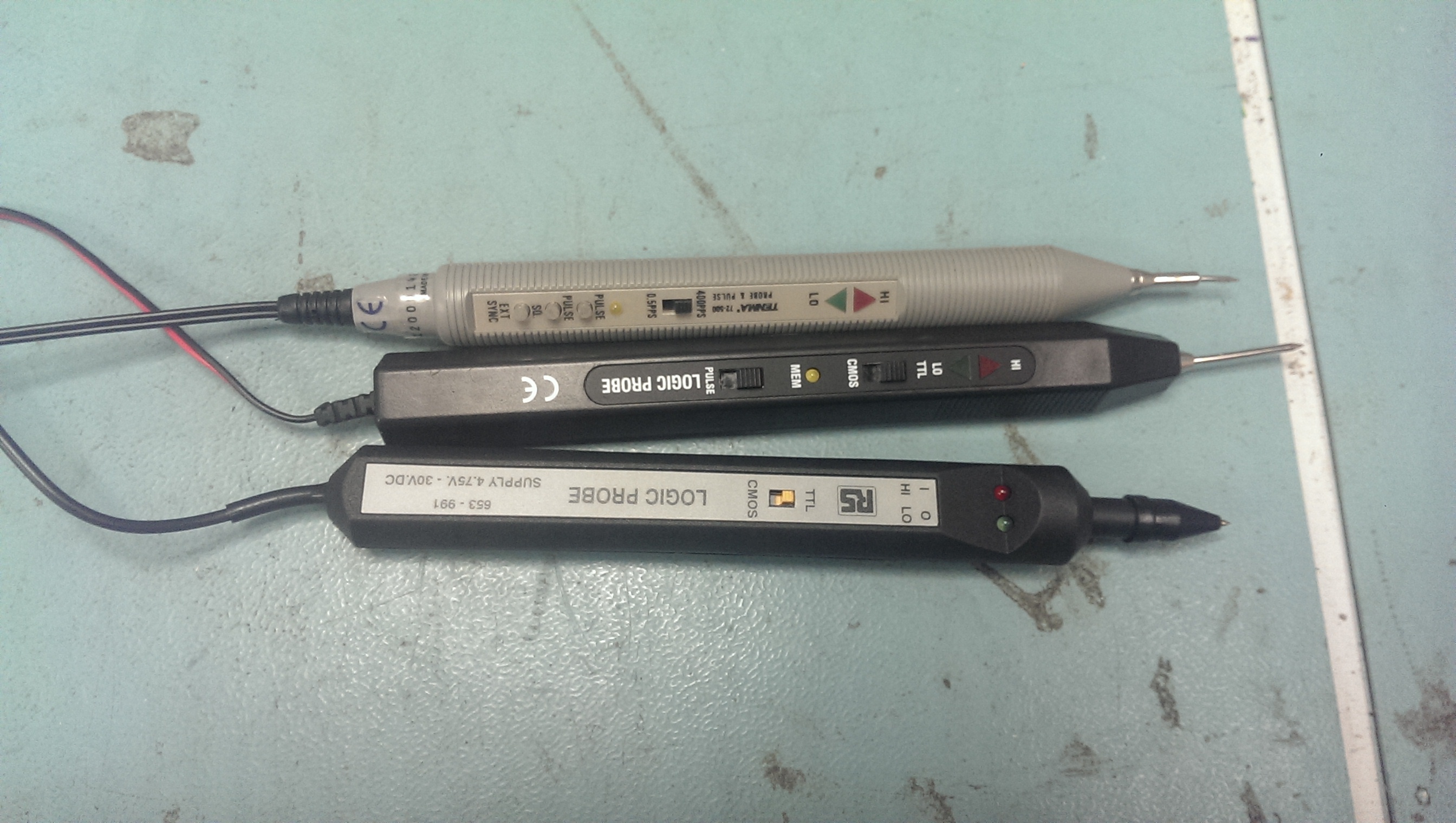
So here are what I’ve got.
IMAG1589

Top one is a Tenma branded one (also seen this under different brand names). This is my probe of choice.
Second one is an unbranded one. Used this once and it feels really cheap in hand but it does have a buzzer in it to accompany the LED’s which is nice.
Lastly is an RS branded one. This is a recent eBay purchase bought mainly for this write-up.

First off, lead length.
There is nothing worse than being restricted but short leads when probing around a board.
Tenma = 58cm
Unbranded = 146cm
RS = 171cm

So my probe of choice has the shortest lead length. I must admit it has hindered me in the past.

To test the logic thresholds I used my programmable PSU and used the outputs that have a common ground.
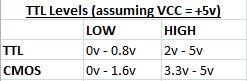
Here are the ‘official’ threshold levels according to Wikipedia for TTL and CMOS (assumming VCC = +5v).
logic levels

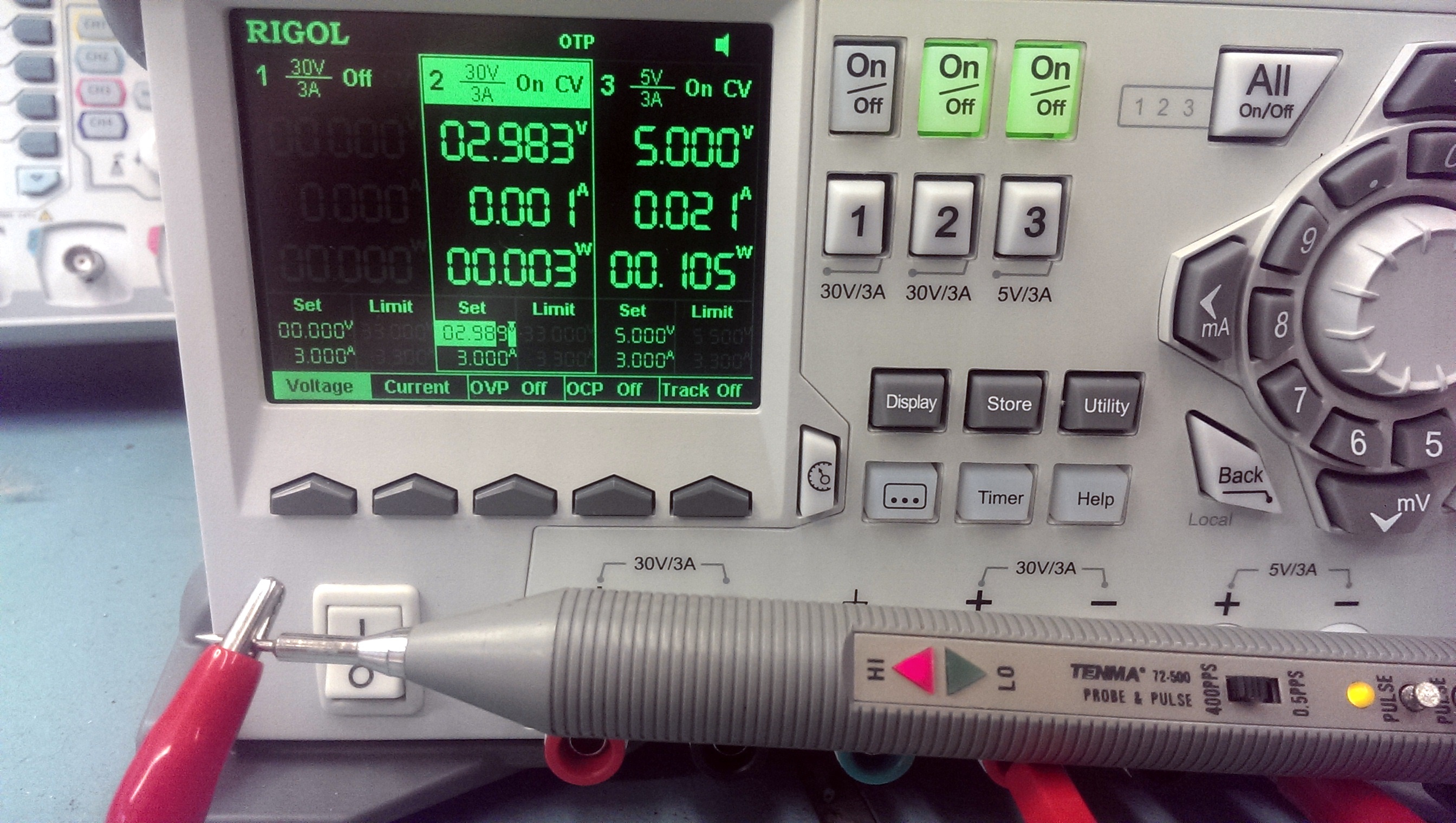
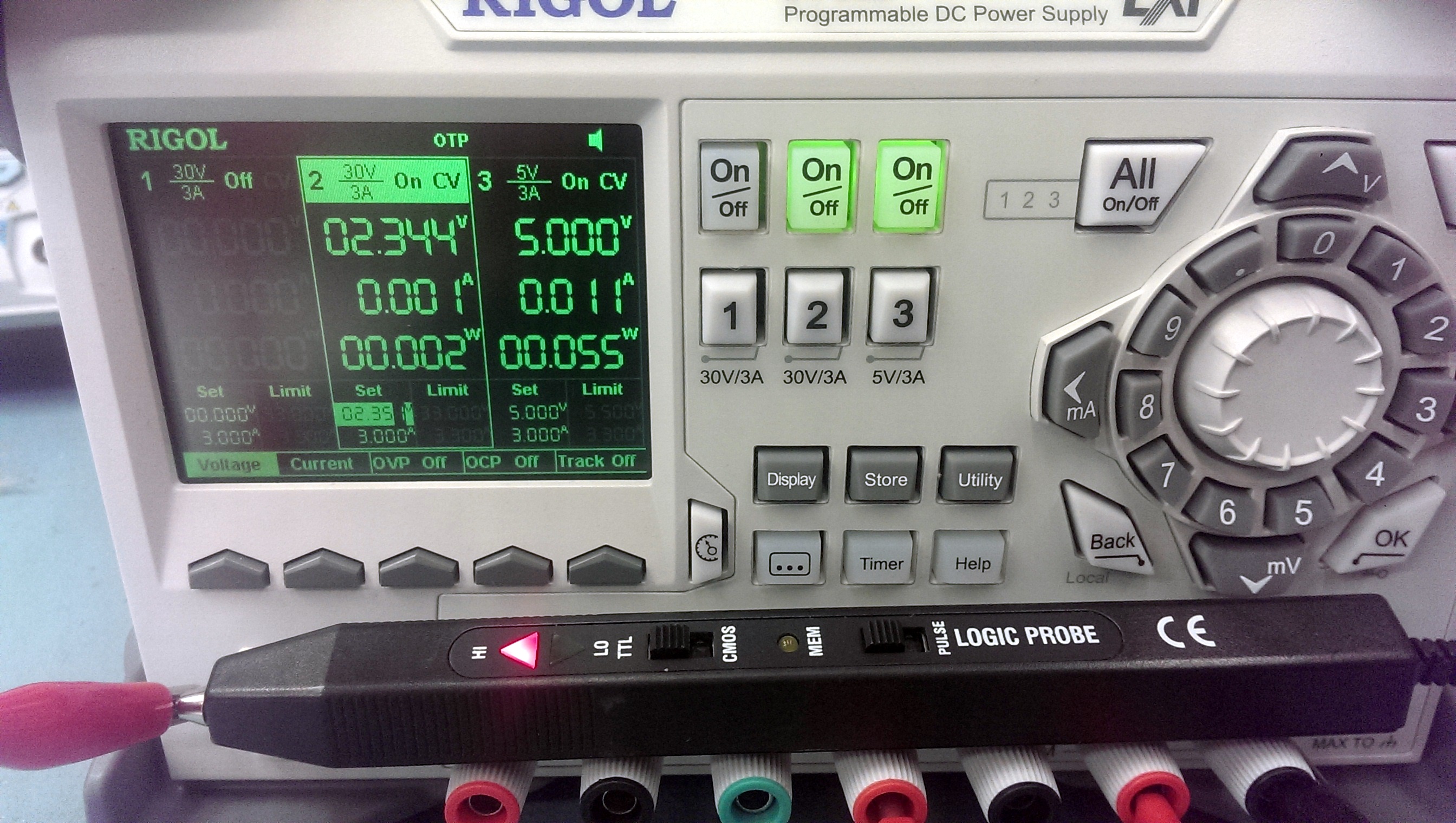
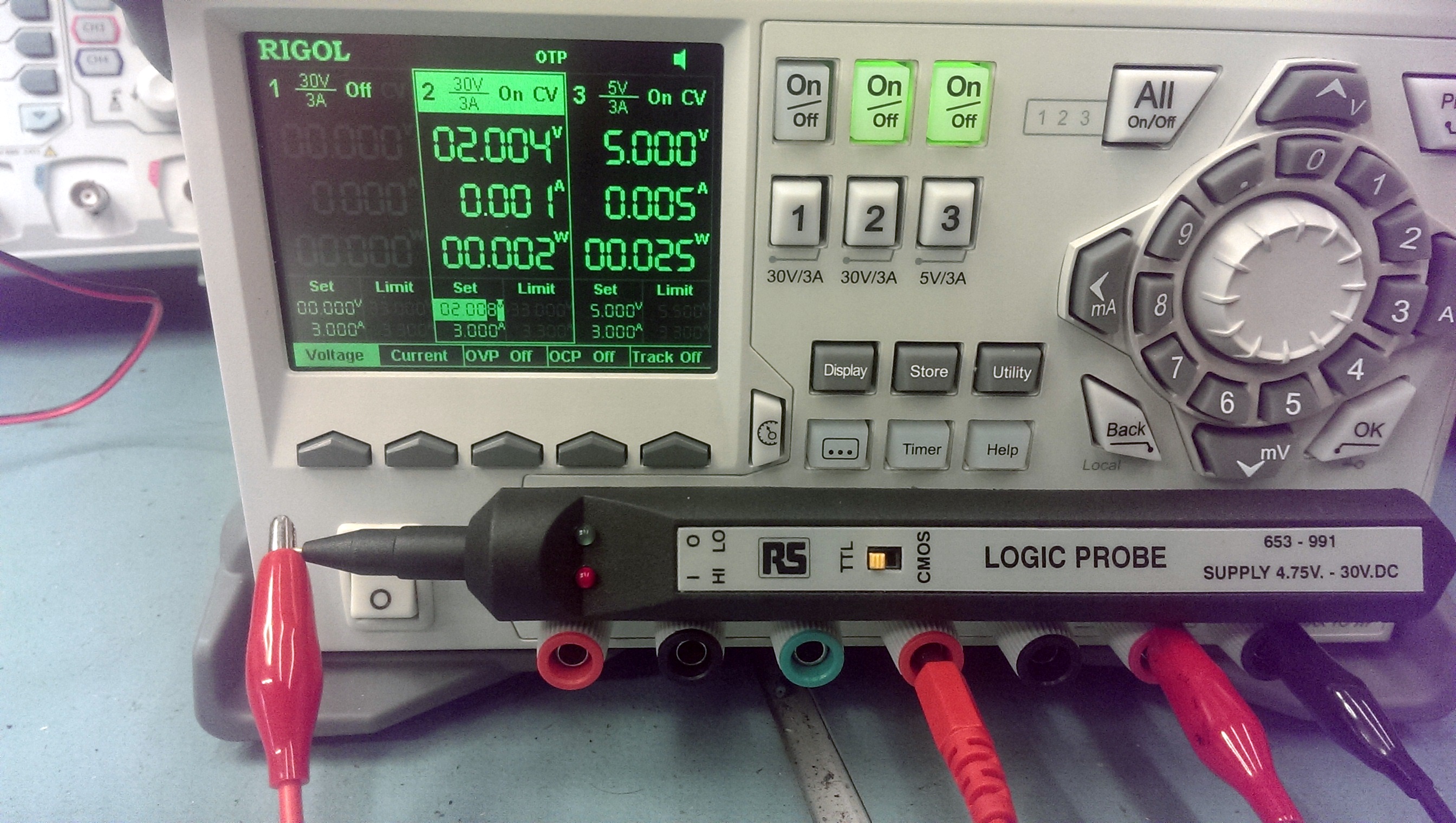
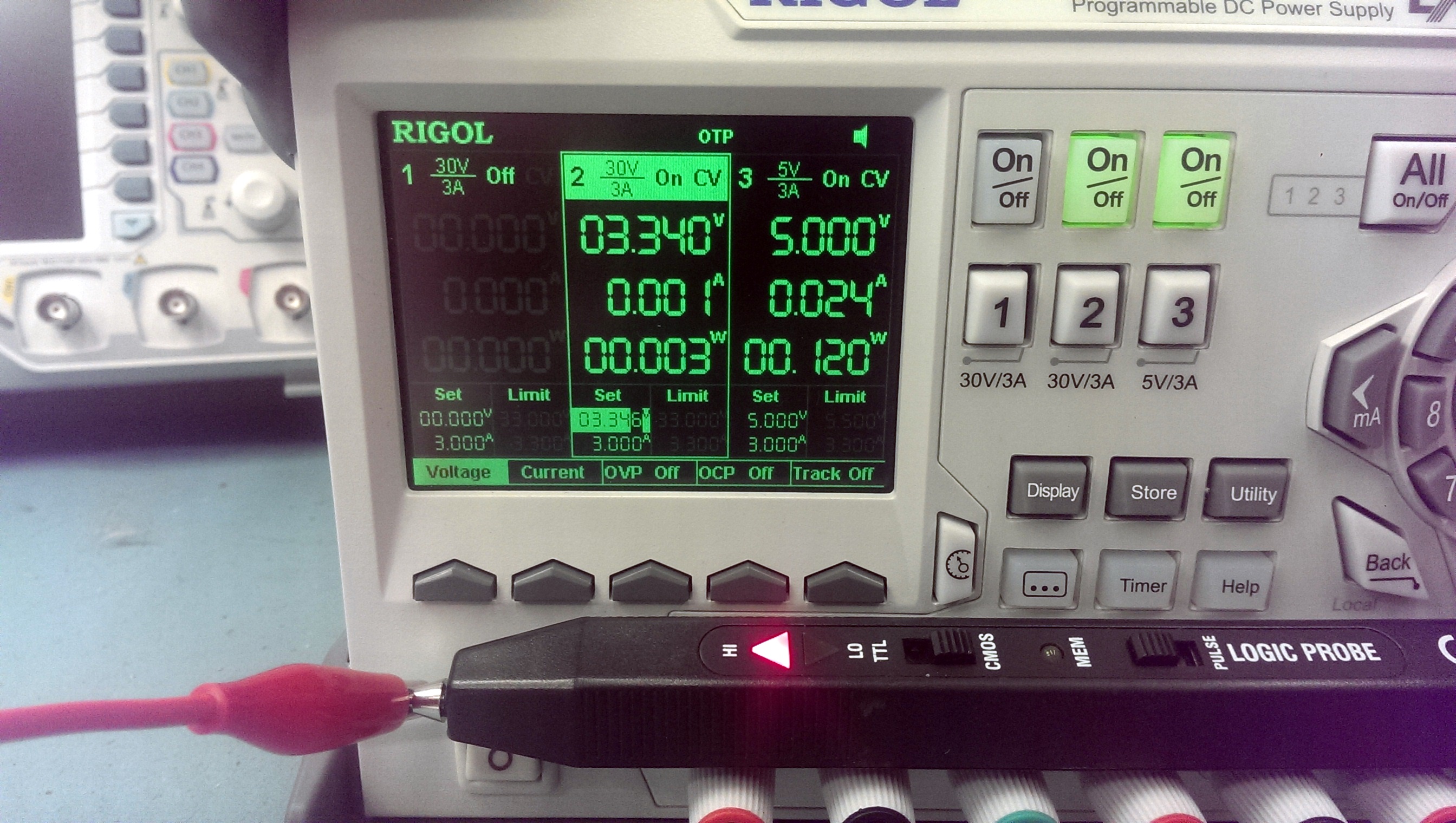
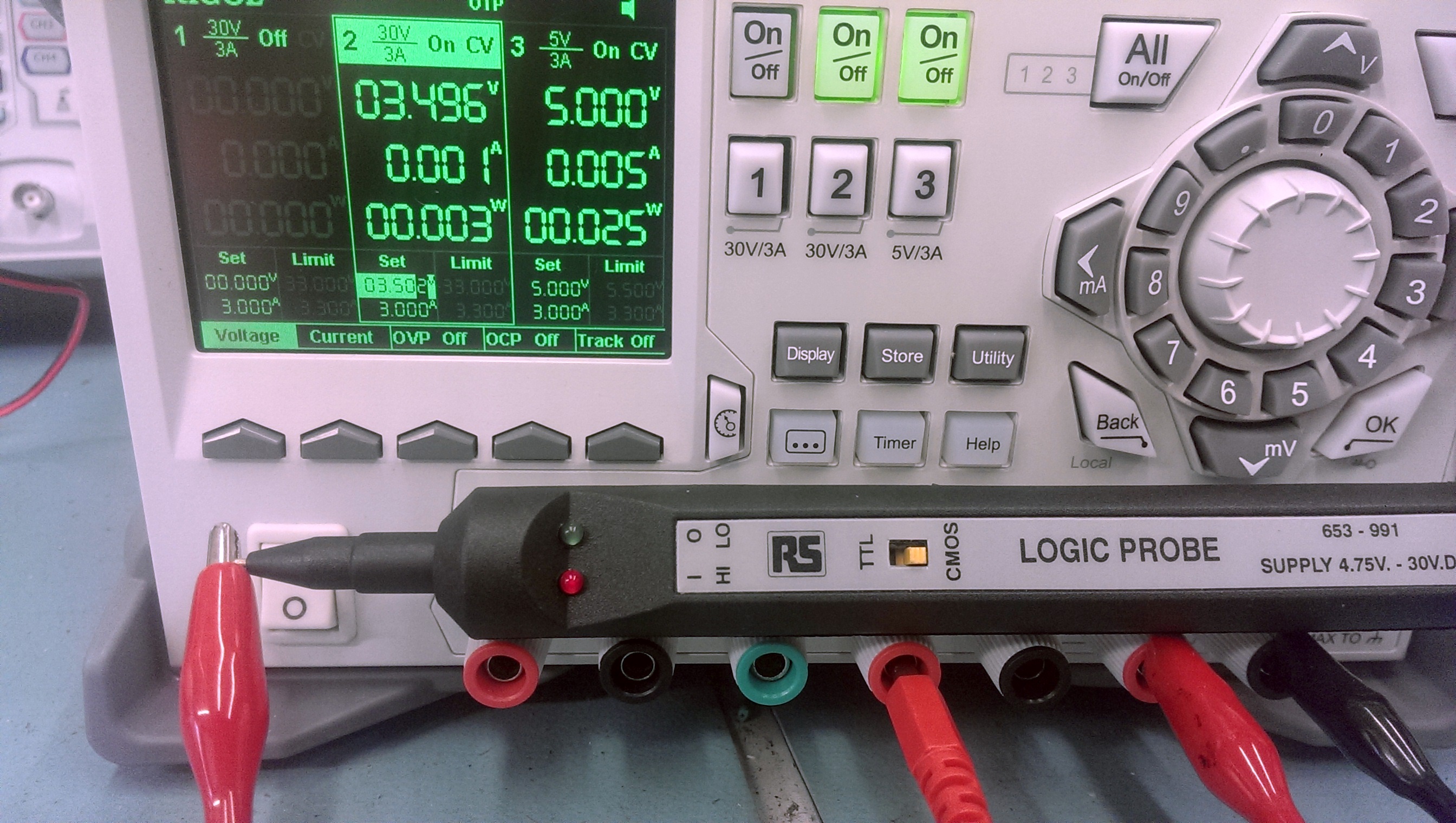
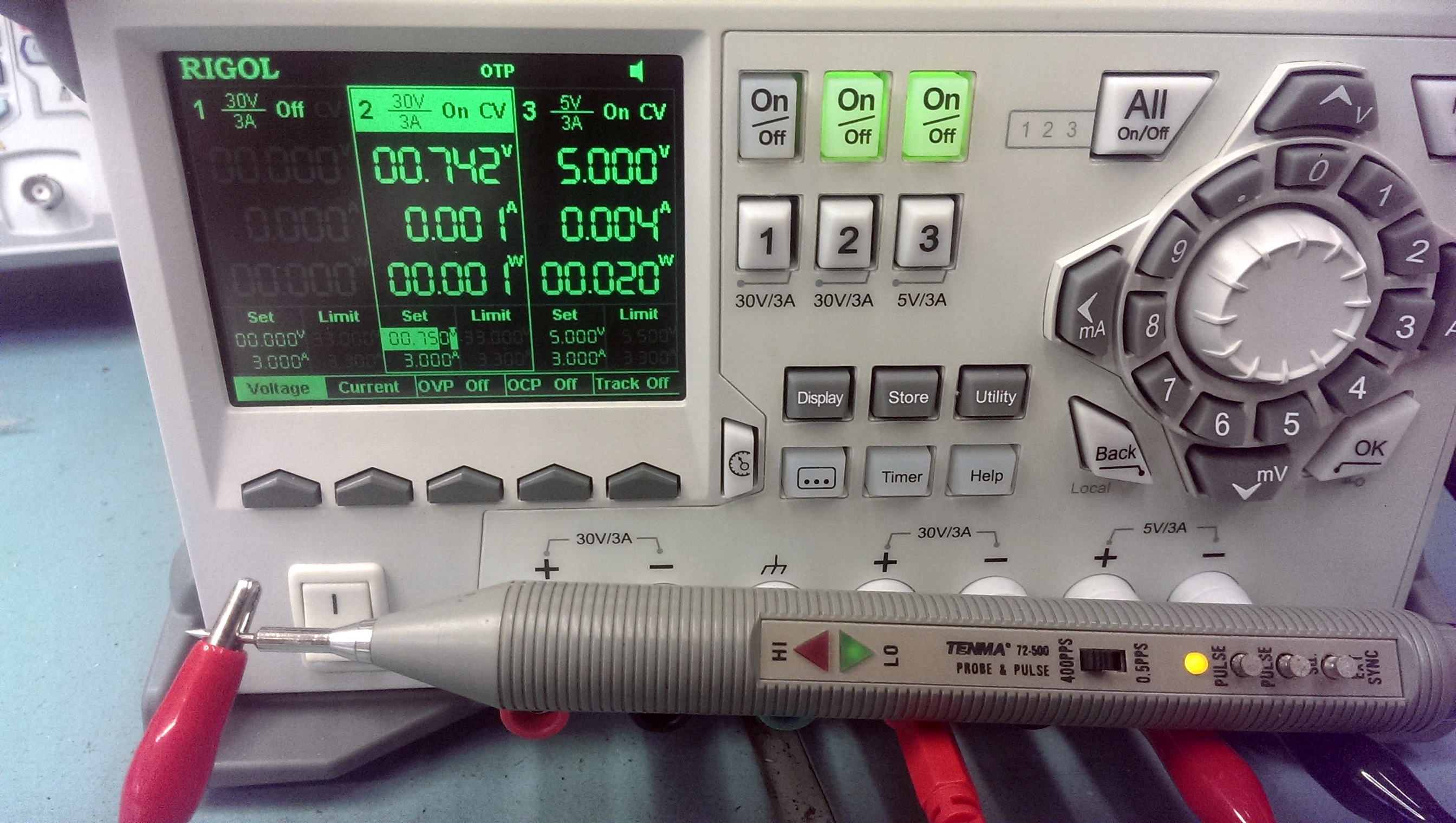
The pictures below show the voltage at which the LOW LED goes OFF and the voltage at which the HIGH LED comes on.
Lets look at the Tenma probe to start with.
This probe only supports TTL logic levels where as the other two can switch between TTL and CMOS.

NOTE: You want to be looking at the smaller voltage settings at the bottom (under ‘Set’). This is the actual voltage settings and was checked for accuracy with a Fluke multimeter.

LOGIC LOW THRESHOLD (TTL)
Tenma Low_on

LOGIC HIGH THRESHOLD (TTL)
Tenma High_on

As you can see the LOW level begins to show around 0.1v below the stated thresholds. Not too bothered about that. Whats more worrying is the HIGH trigger point, its nearly 1v out of spec.

Next up is the unbranded probe

LOGIC LOW THRESHOLD (TTL)
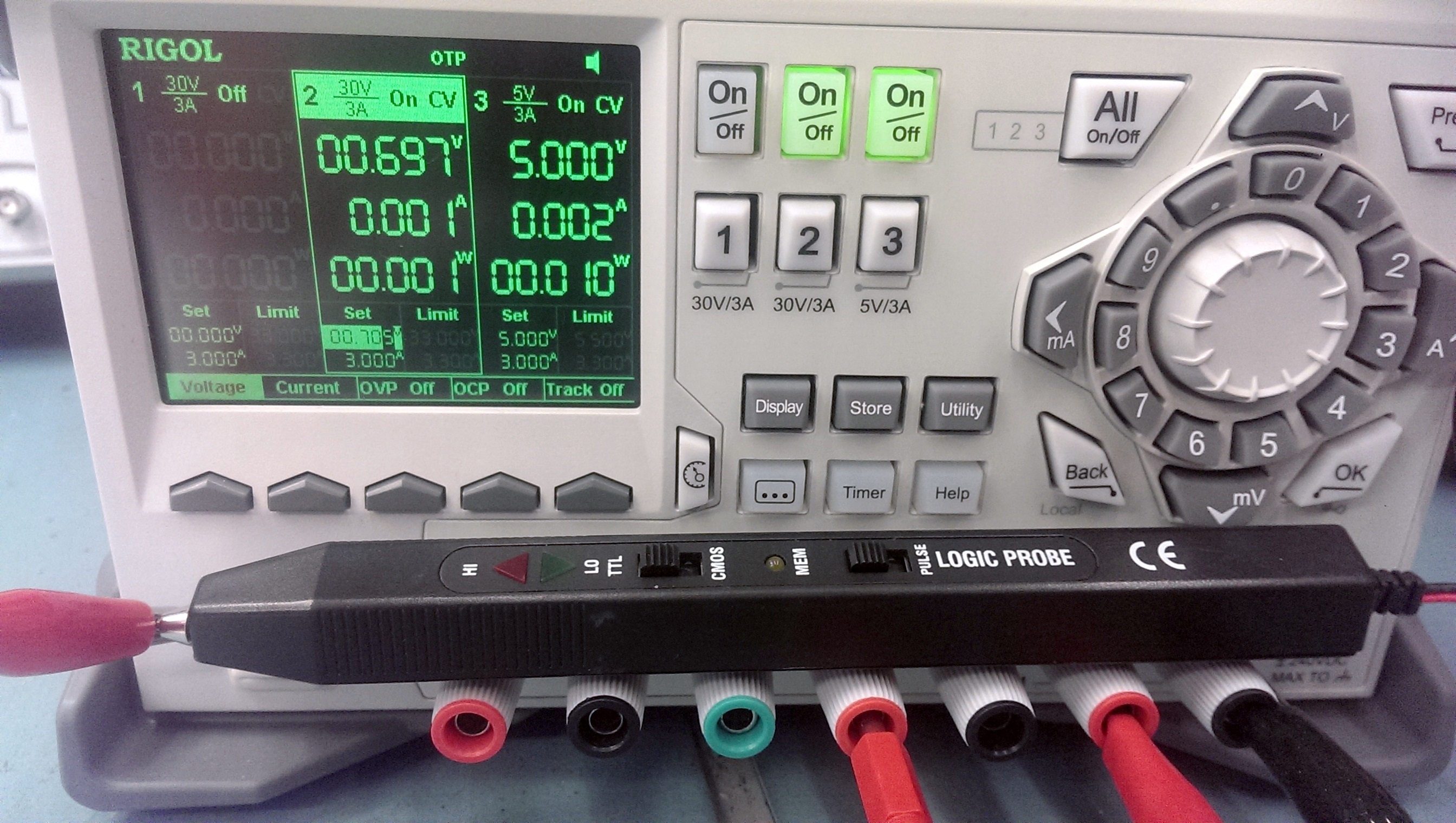
TTL-UB Low_off

LOGIC HIGH THRESHOLD (TTL)
TTL-UB High_on

This has similar LOW trigger levels as the Tenma one and the HIGH trigger is around 0.7v lower bringing it nearer to the thresholds stated. Not too bad.

Finally the RS branded probe. The pictures are pretty useless here as the low brightness level of the probe at these voltages make it difficult to capture on camera but its there.
LOGIC LOW THRESHOLD (TTL)
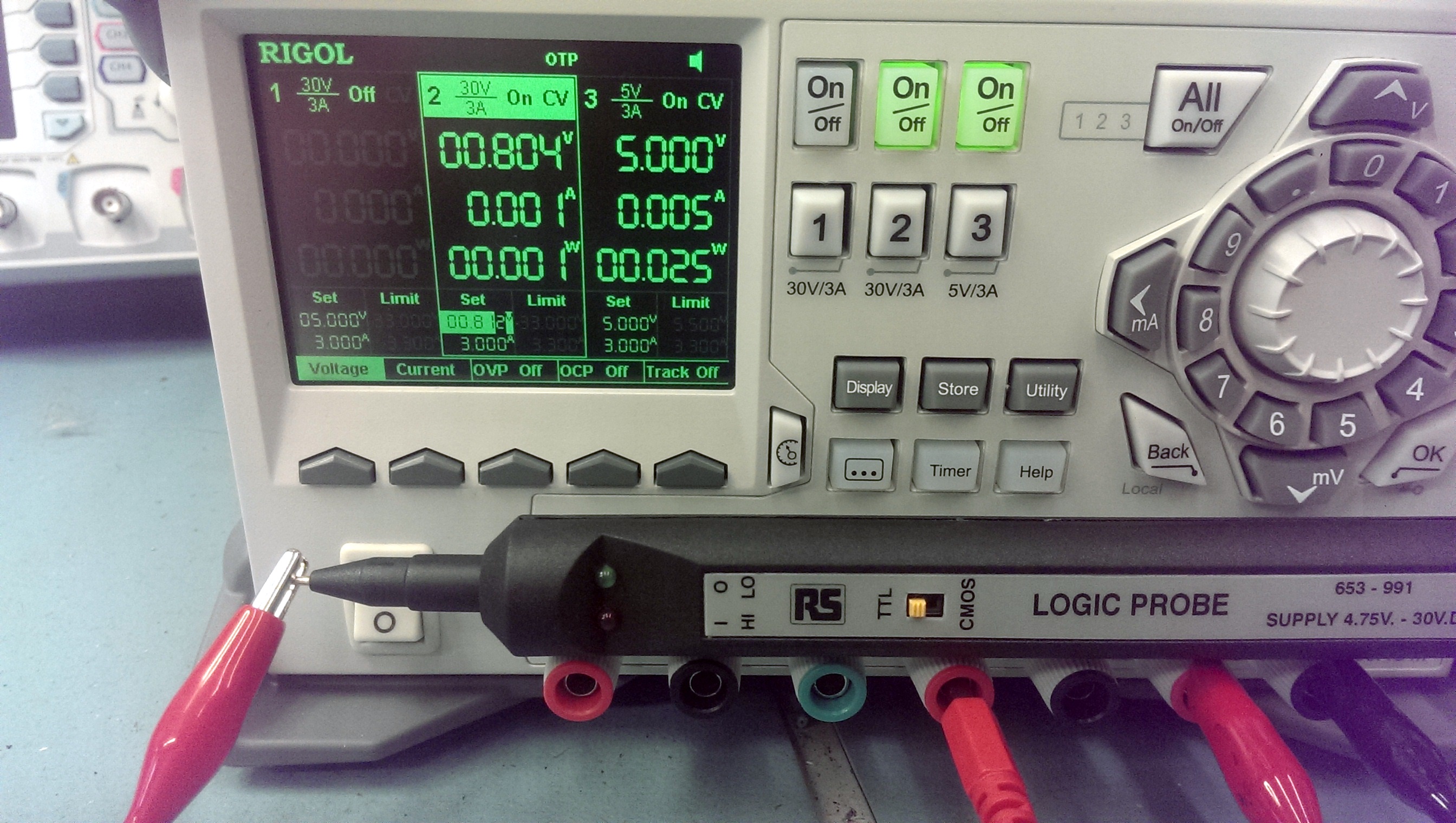
TTL-RS Low_off

LOGIC HIGH THRESHOLD (TTL)
TTL-RS High_on

Results are very positive for this probe on the TTL setting.

Next I test the CMOS setting. As the Tenma cannot support CMOS it is obviously excluded from this test.
Unbranded first.

LOGIC LOW THRESHOLD (CMOS)
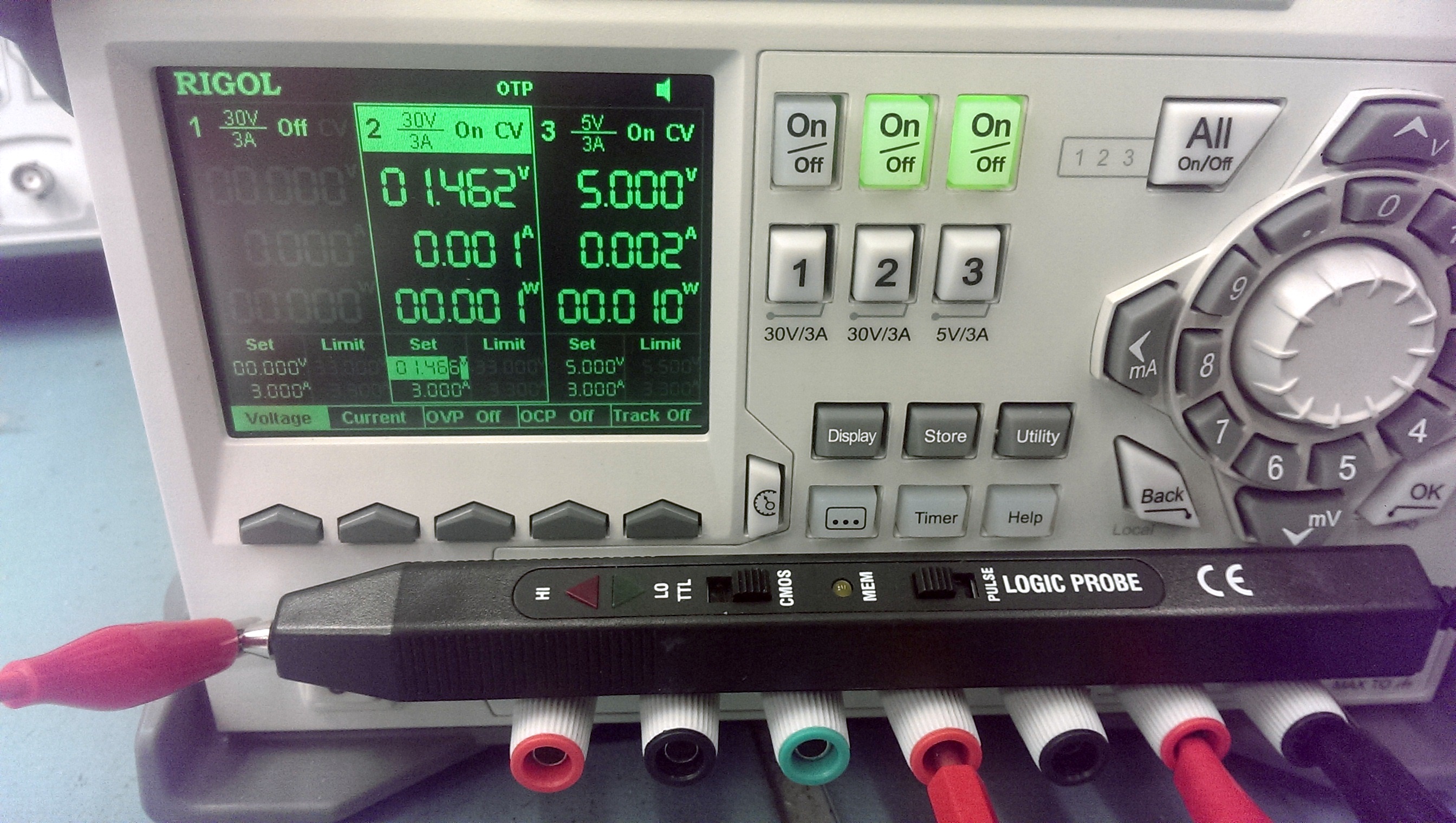
CMOS-UB Low_off

LOGIC HIGH THRESHOLD (CMOS)
CMOS-UB High_on

The LOW trigger is a bit low here but the HIGH is pretty good.
Now for the RS probe. Once again the pictures are pretty rubbish as the low level of the LED doesnt really show up on the camera but I assure you it is there.

LOGIC LOW THRESHOLD (CMOS)
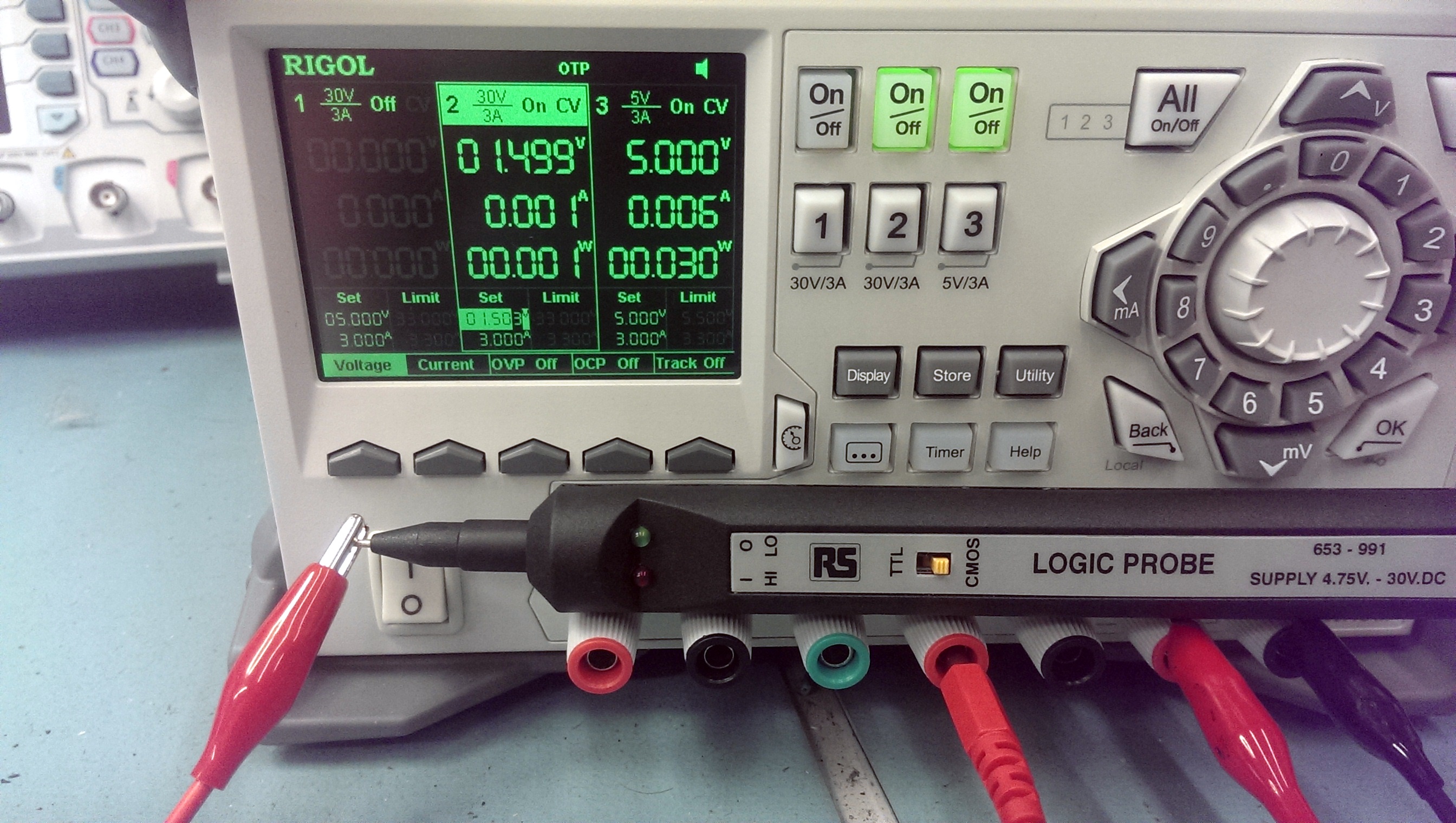
CMOS-RS Low_off

LOGIC HIGH THRESHOLD (CMOS)
CMOS-RS High_on

The LOW trigger is much the same but the HIGH is a little higher than the unbranded.

So here we have the full results
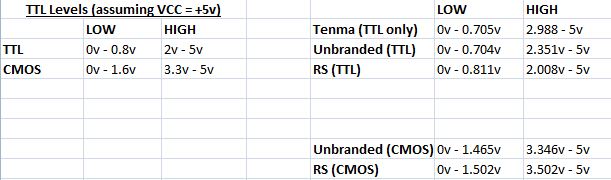
results

This test wasn’t the greatest and it is only my interpretation of it. For example, should I have taken readings when the LED’s were at full illumination? Different people will prefer different things.
The unbranded probe didn’t seem to have that dimming of the LED’s depending on the voltage. It was clearly either ON or OFF. Whether this is a good or bad thing will depend on user preference. For me its not too good. This probe however is the only one to have the buzzer which is a nice thing to have sometimes.
I think for me the RS probe will now be my probe of choice. It has nice long leads, feels good to hold and use and the results were decent too.
 Posted by at 1:19 pm
Aug 292015
 

As Ive mentioned in my repair log of the Fluke 90 there is some useful functionality that is only available when connected to a PC.
These features appeal to me but I dont have an old PC lying around in order to use the ancient DOS program for this so I made my own.
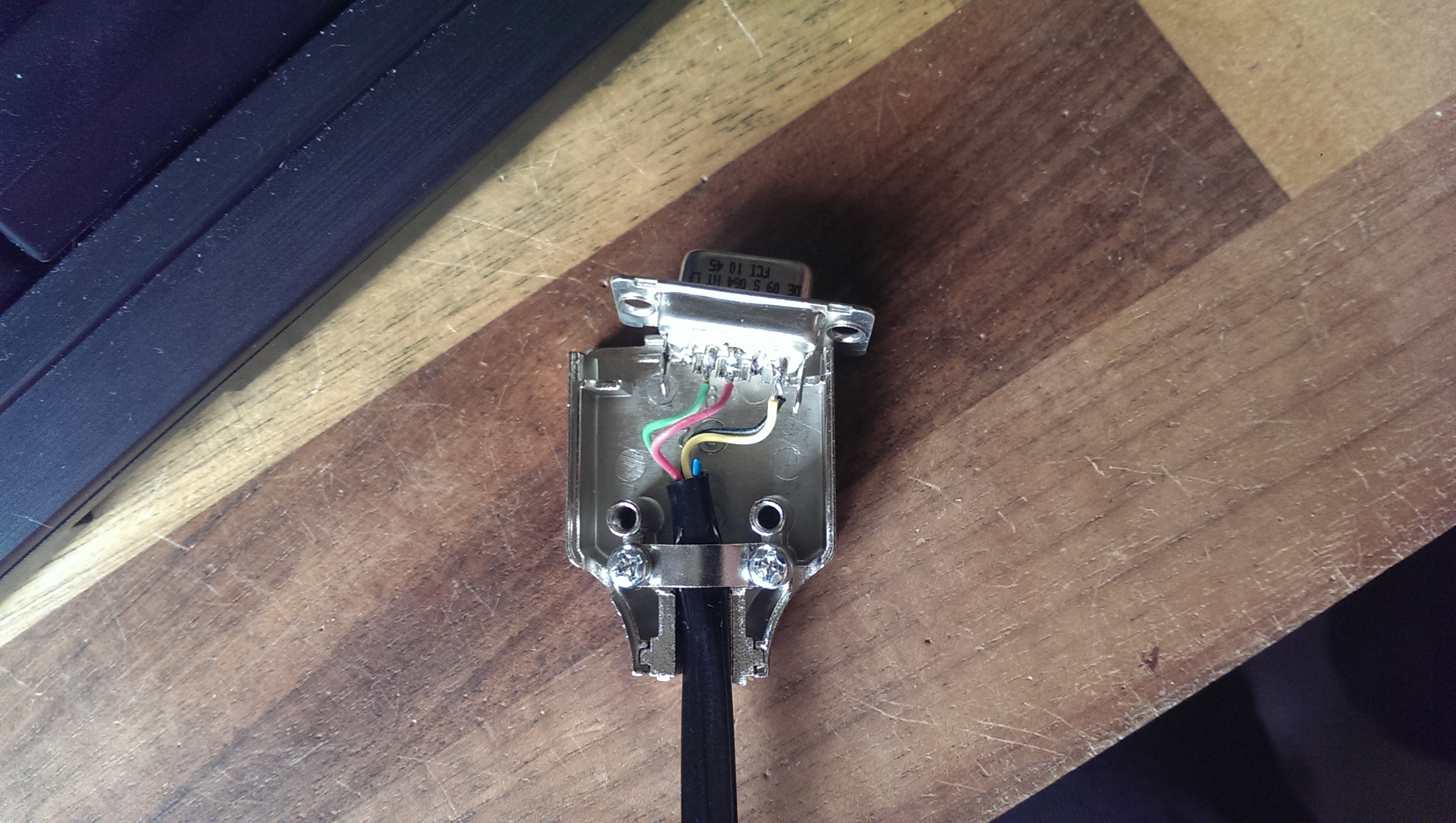
What I do have is an RS232 to USB converter so I removed the DB25 connector and changed it for a standard 9 pin variety.
IMAG1493

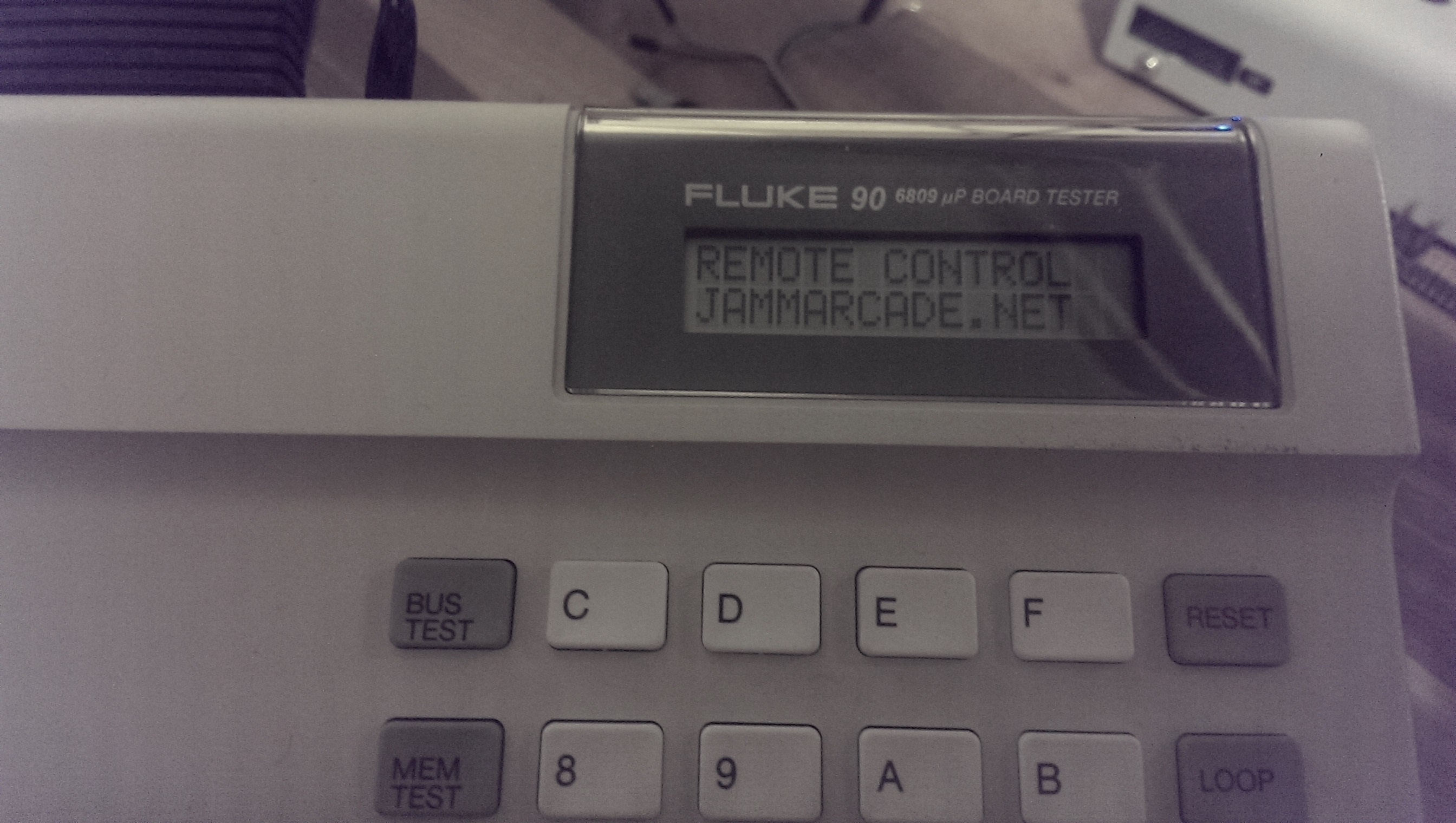
With that made up I could quickly test it was correct by firing up a terminal window and sending any command. If successful the Fluke will display “REMOTE” on the LCD.

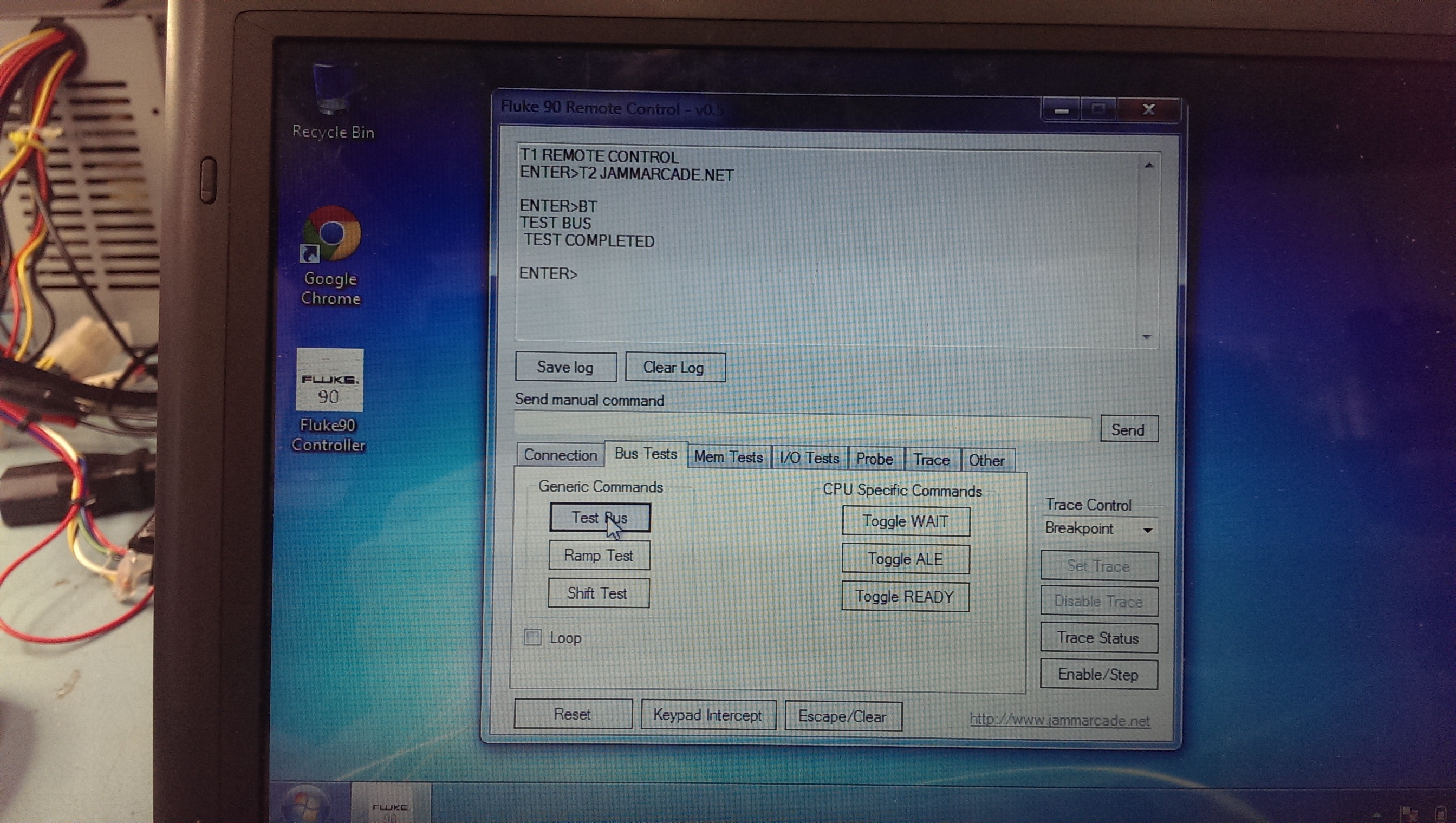
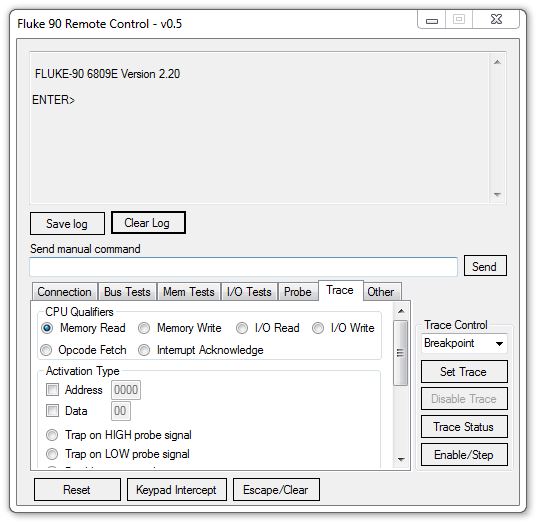
Here is the software I have been working on the last couple of days.
fluke90RC

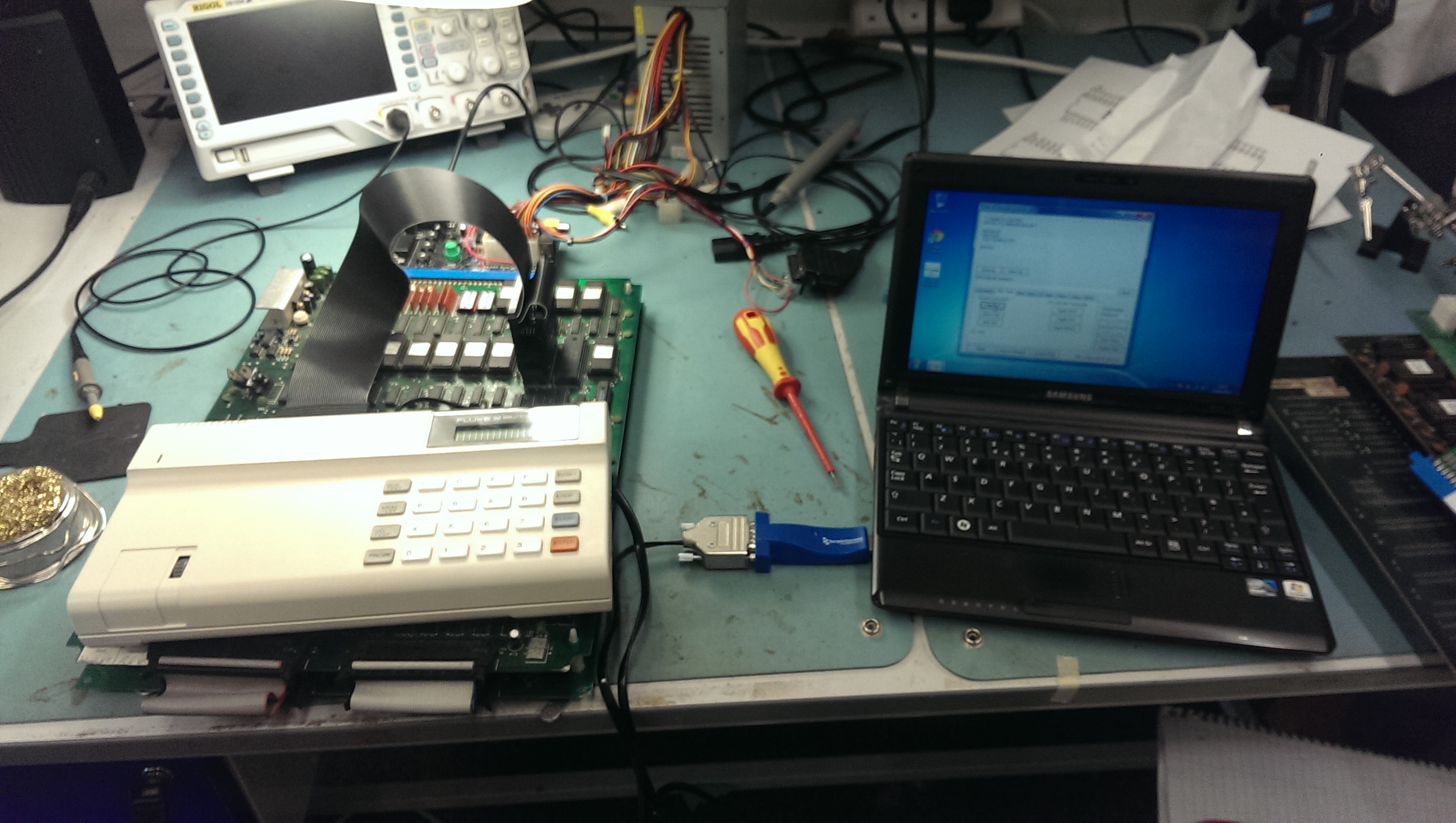
Here it is all connected up to Breywood and working
IMAG1500
IMAG1498
IMAG1501

Its not finished yet and certain things will be tweaked and changed and added in time but I successfully tested it today and almost everything works great.
I still need to work on the UPLOAD and DOWNLOAD functionality but the tracing works fine which is what I was most interested in.

I cant imagine many/any people wanting this program but here it is anyway. It should be compatible with all the Fluke 90 devices. There are some CPU specific commands here which are included despite the fact I cannot test them.

It requires .NET 3.5 and should work on both 32bit and 64bit machines. Available in the ‘DOWNLOADS/SOFTWARE’ section

 Posted by at 11:22 am

Quick ROM ident program

 General  Comments Off on Quick ROM ident program
Aug 152015
 

I loved the old WinROMident program for its quick usage but unfortunately it hasnt been updated in a long time.
Ive made a new drag and drop program that uses Romcenter .DAT files
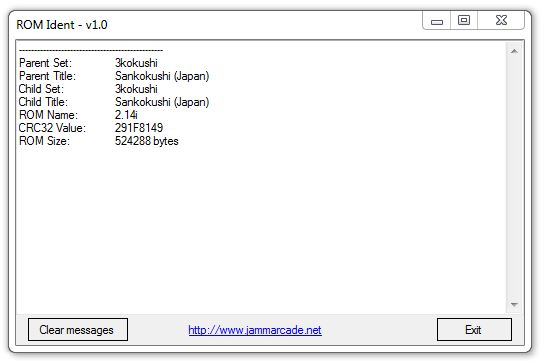
romident

It doesn’t yet support zip files, only single files.
As with everything I make it requires .NET (v4.5) installed on your computer and it probably has a load of bugs too.
Its minimal and quick which is exactly what I need.

Can be found in the Downloads/Software section

 Posted by at 4:20 pm
Aug 052015
 

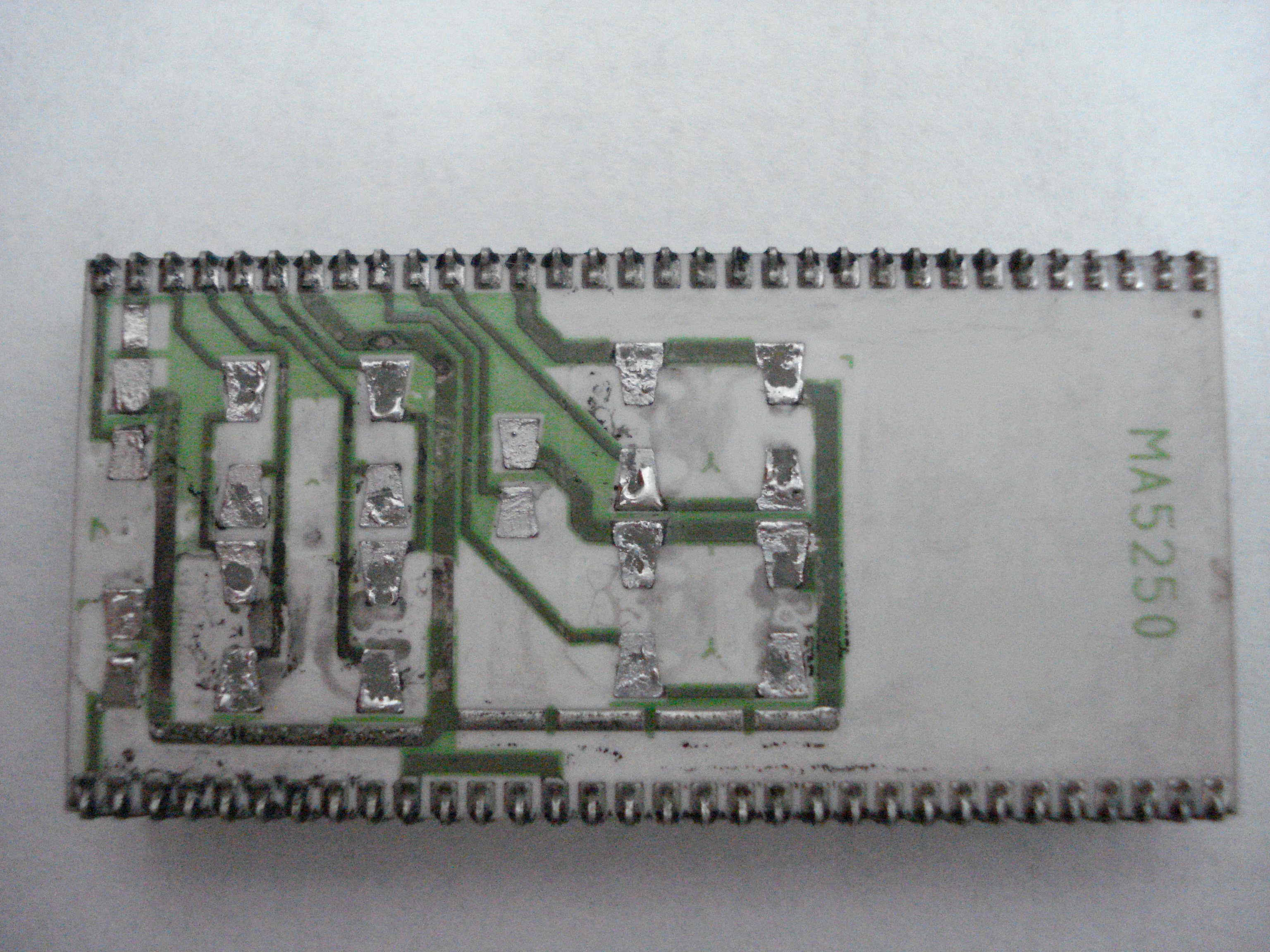
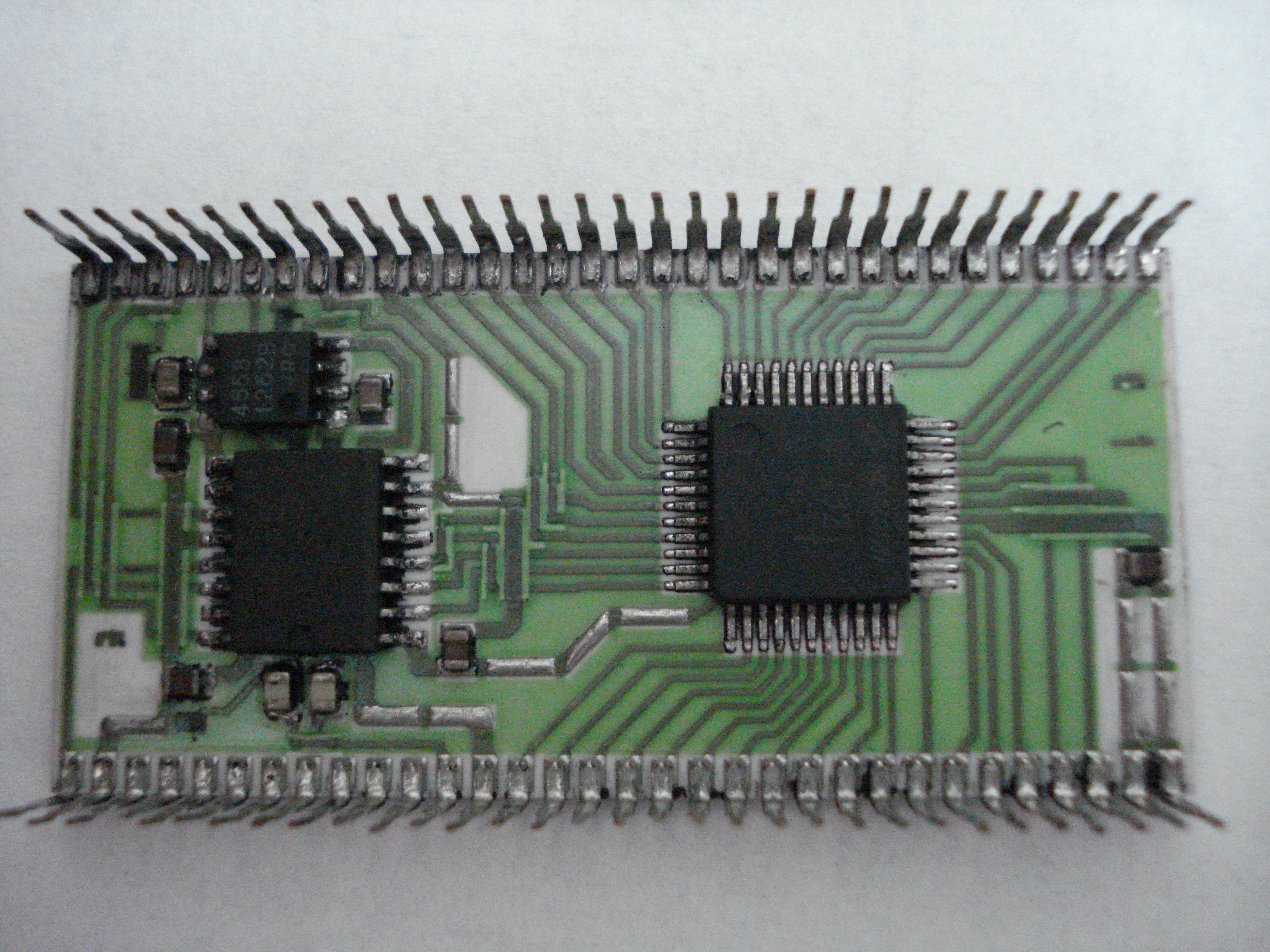
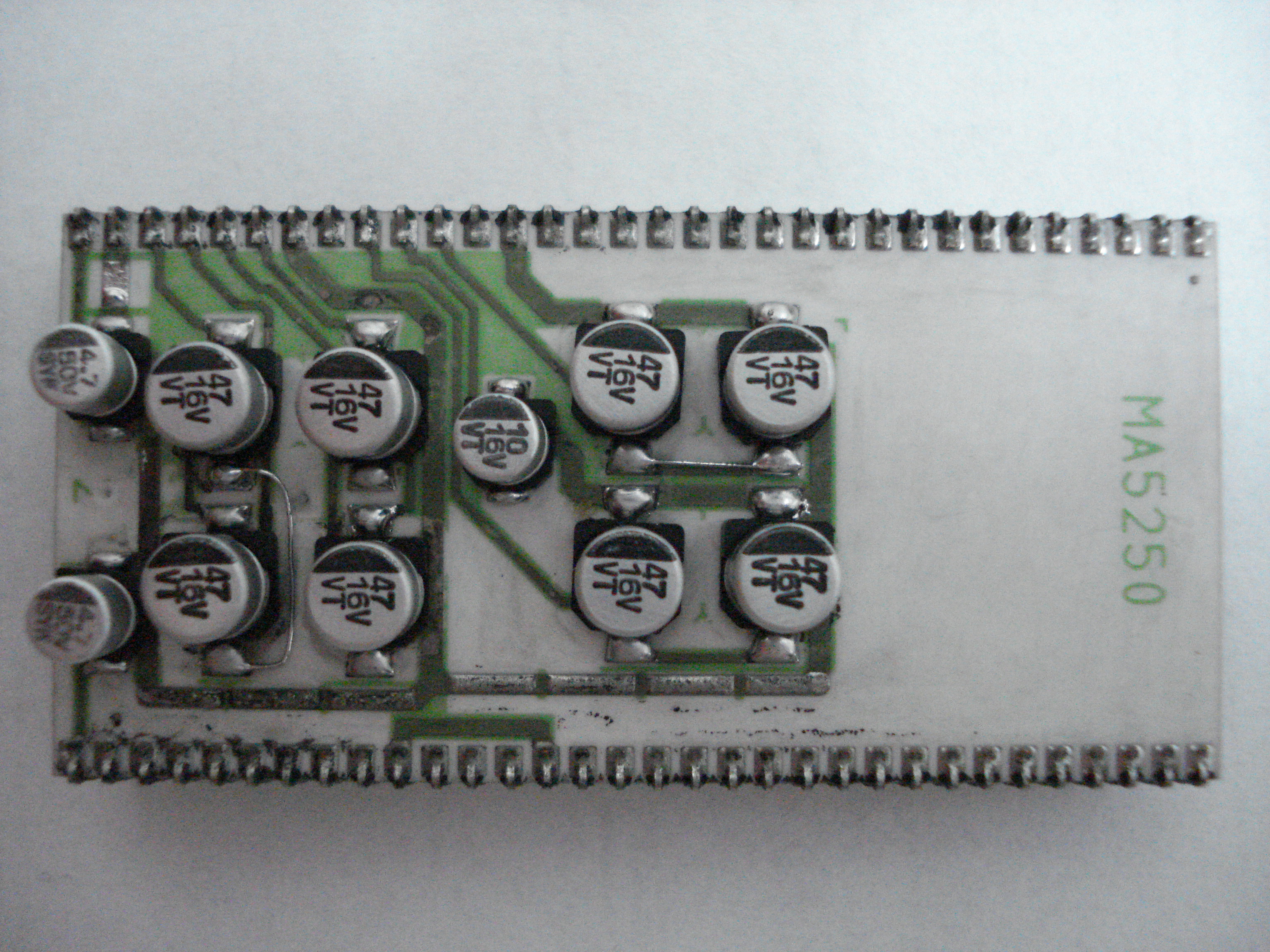
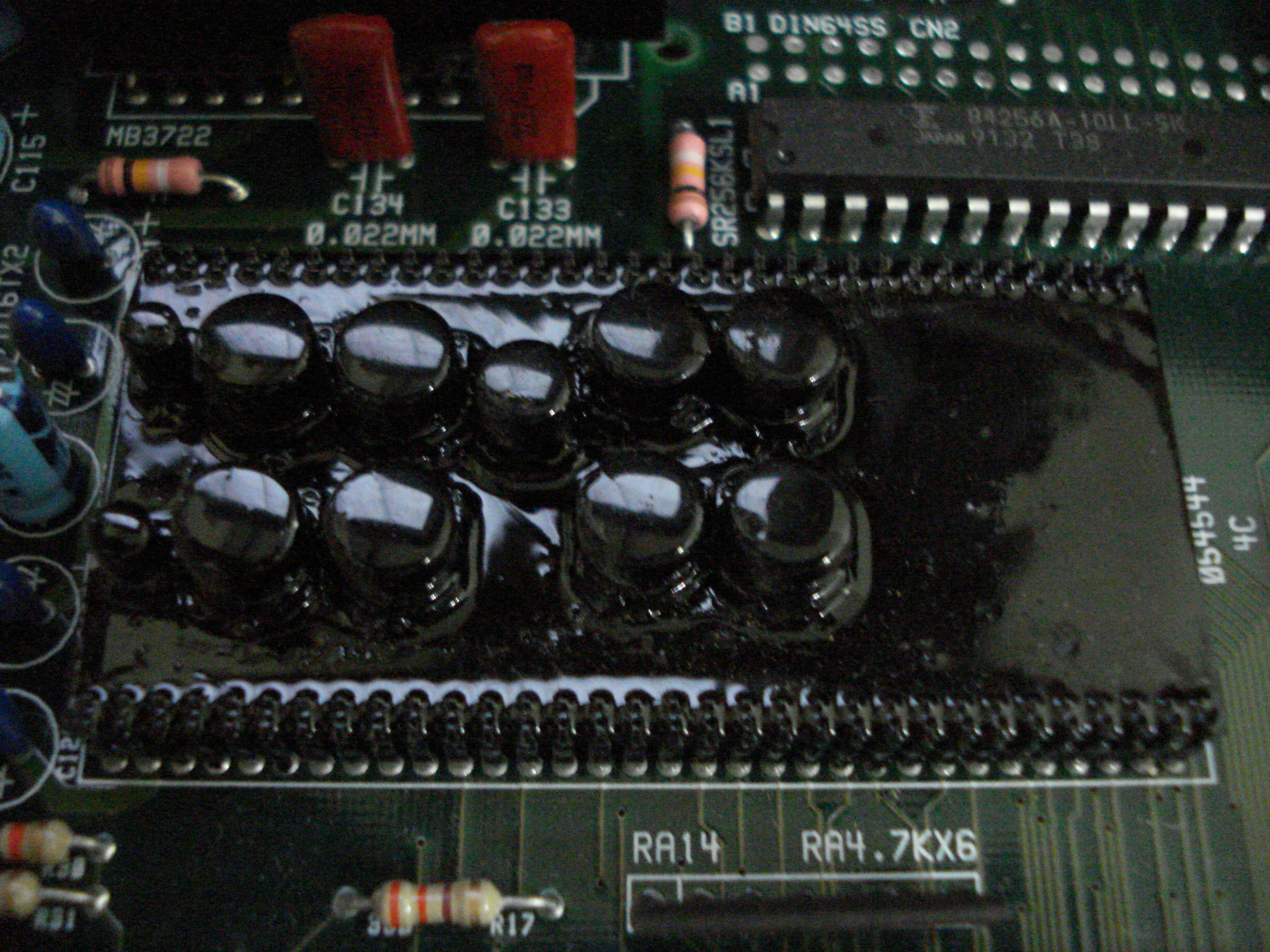
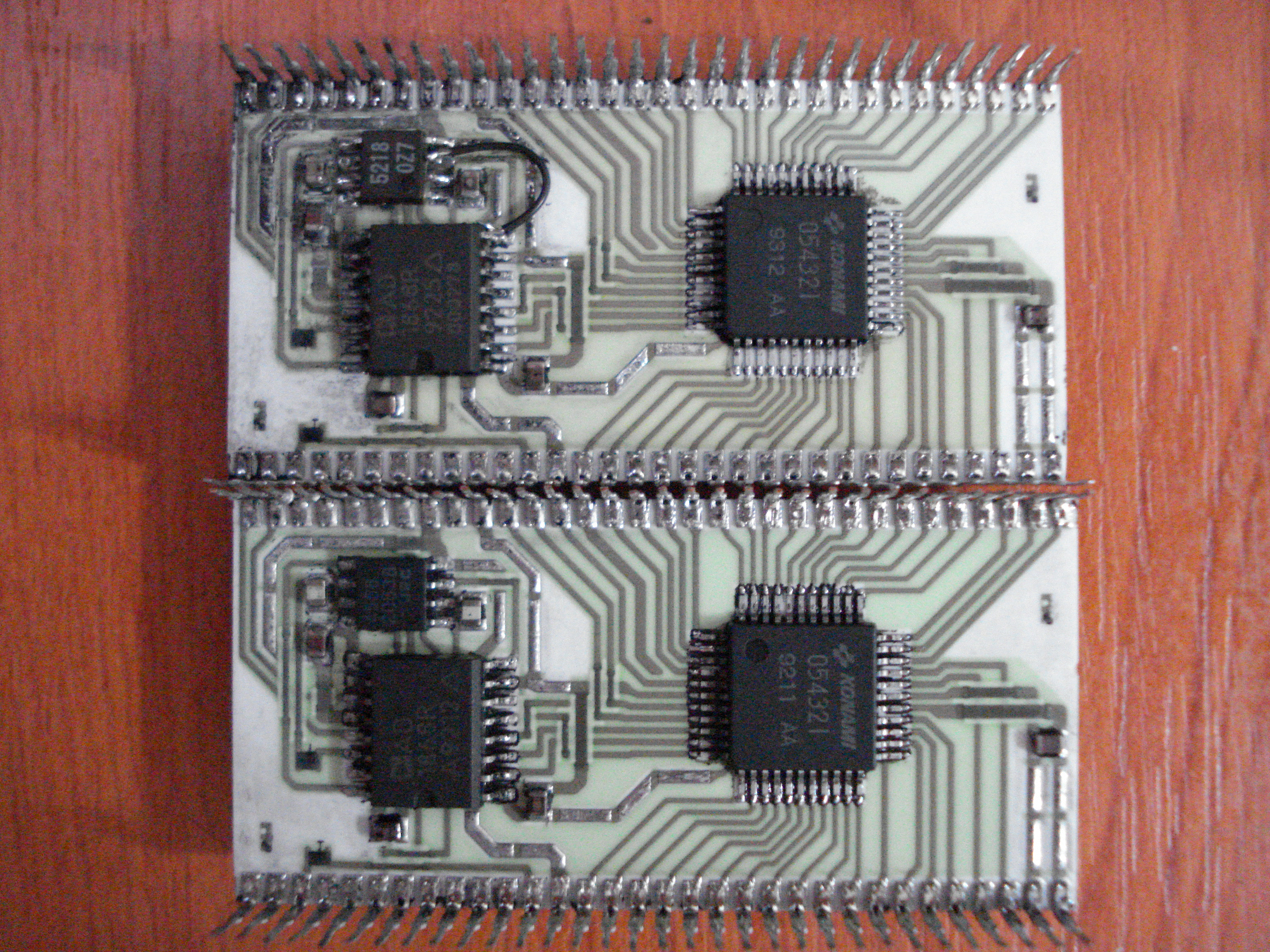
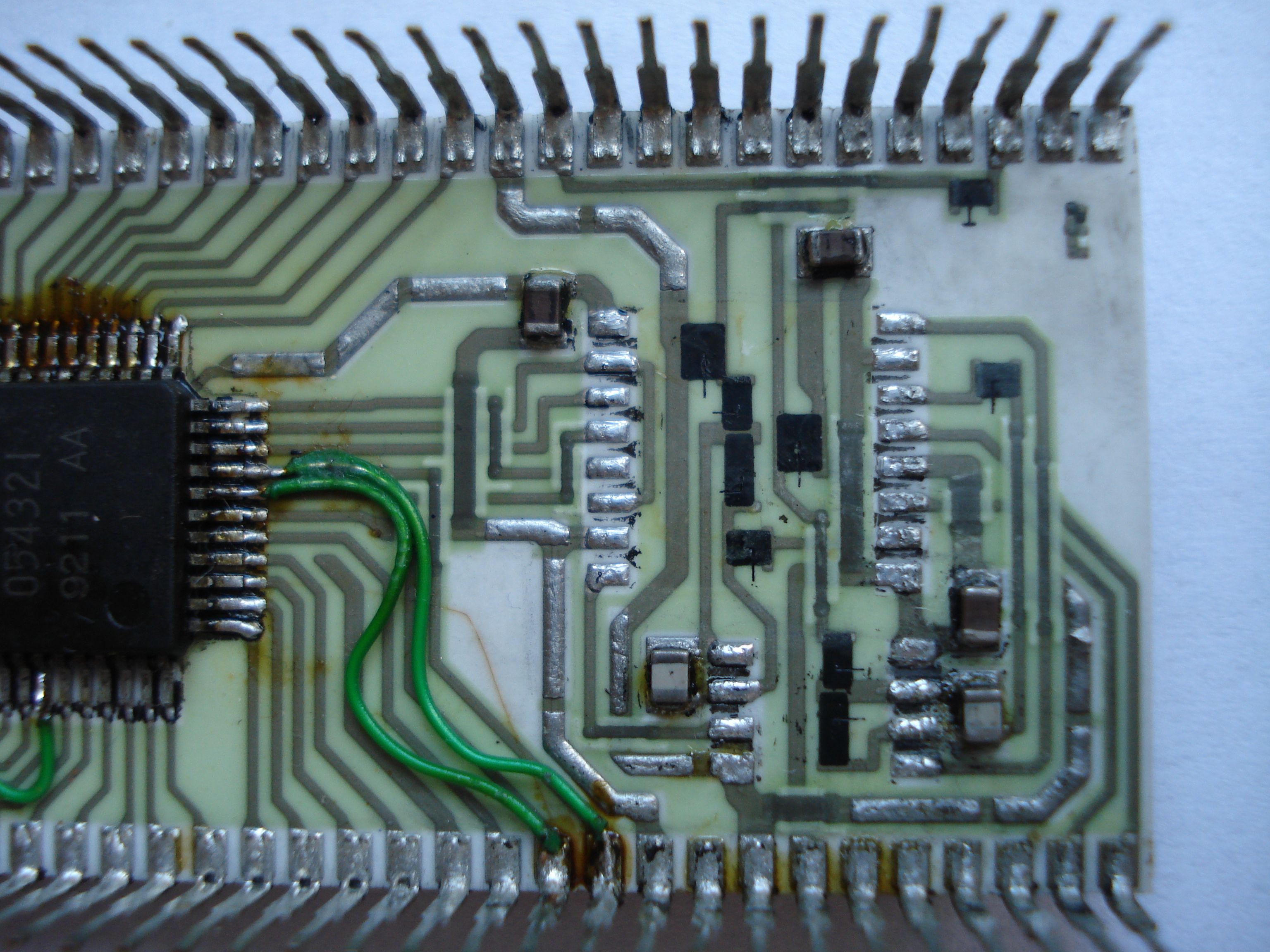
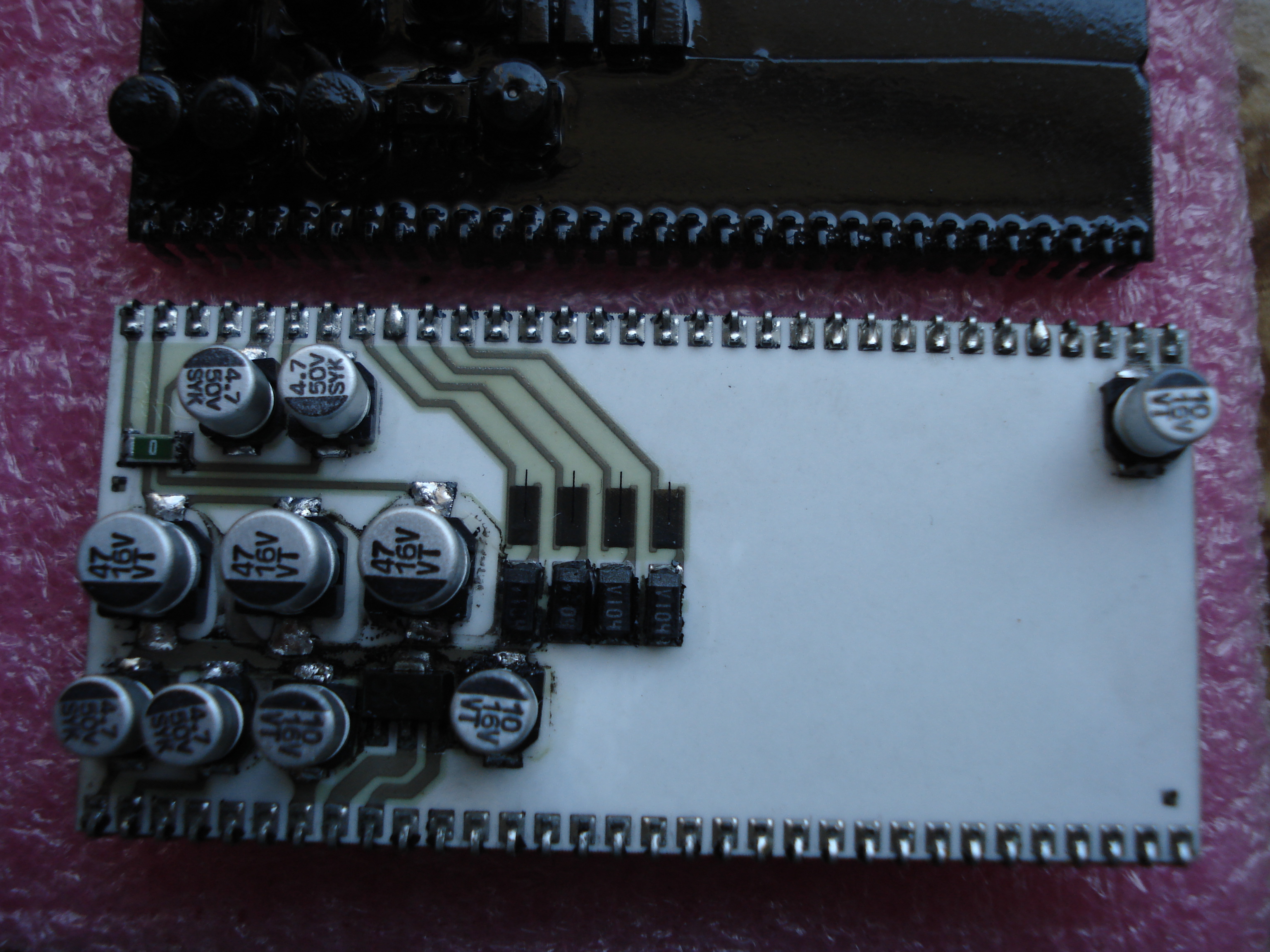
Some days ago Dragos sent us some pictures of his Konami hybrid sound modules reworking.As most of you already know, this customs are used in many Konami arcade games.Specifically the ‘054986A’ is used on Lethal Enforcers, G.I. Joe, Metamorphic Force, Run & Gun, Premiere Soccer, Bucky O’ Hare, Violent Storm, Monster Maulers, Martial Champion, Mystic Warriors, Gaiapolis and Wild West C.O.W. Boys of Moo Mesa while the ‘054544’ is present on X-men and Xexex.A common fault on these customs concerns the SMT electrolytic capacitors that after some time start to leak ‘eating’ traces of the module.What Dragos did was to literally ‘undress’ the modules by removing the black paint using this paint stripper (that you can find in your country under a different name) revealing in this way all the traces and connections on top and bottom layer.Needless to say that this is really useful for everyone who wants to troubleshoot the modules.But, here are the pictures for a better understanding.Let’s start with the ‘054544’:

054544_3

054544_4

054544_5

054544_1

A nice black repaint is what it takes after a recap…

Here is below the ‘054986A’ in all its glory:

054986A_0 054986A_2

Above, a close up of jumper wires needed to patch some broken connections

054986A_3

In the picture above you can see the ‘054986A’ top layer exposed.The small IC on the bottom left between the two 10uF 16V capacitors is a 78L05 voltage regulator (SOT-89 package) which powers the 4558 OP-AMP and  the AD1868 DAC on the underneath of the module

054986A_4

Now Konami hybrid sound modules have no more secrets!Thanks again to Dragos.

 Posted by at 10:54 pm