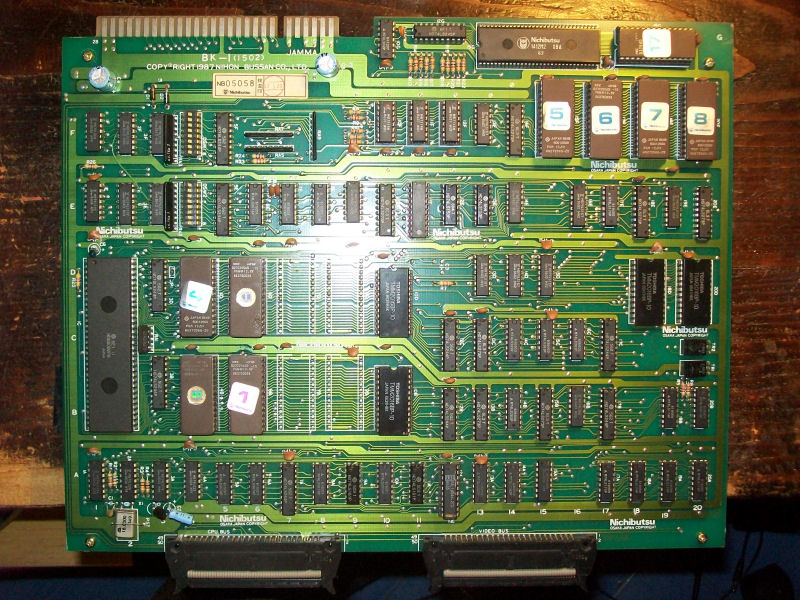
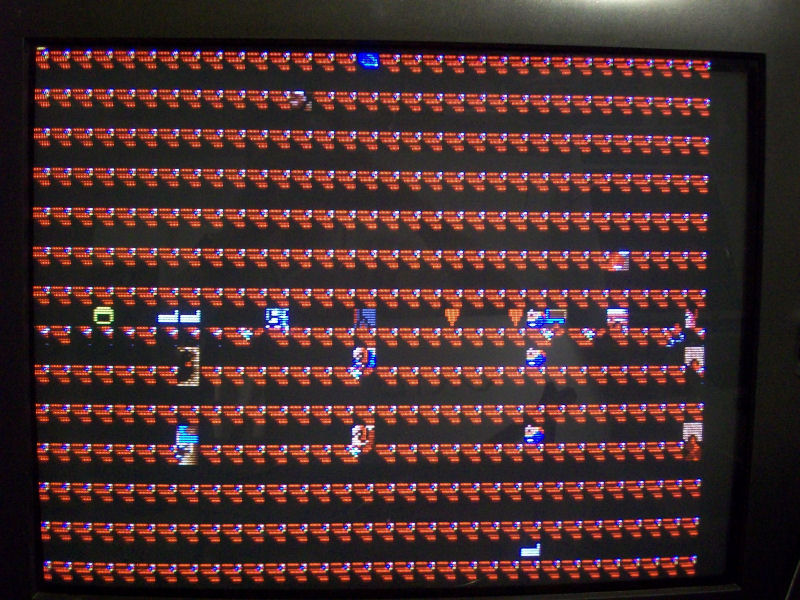
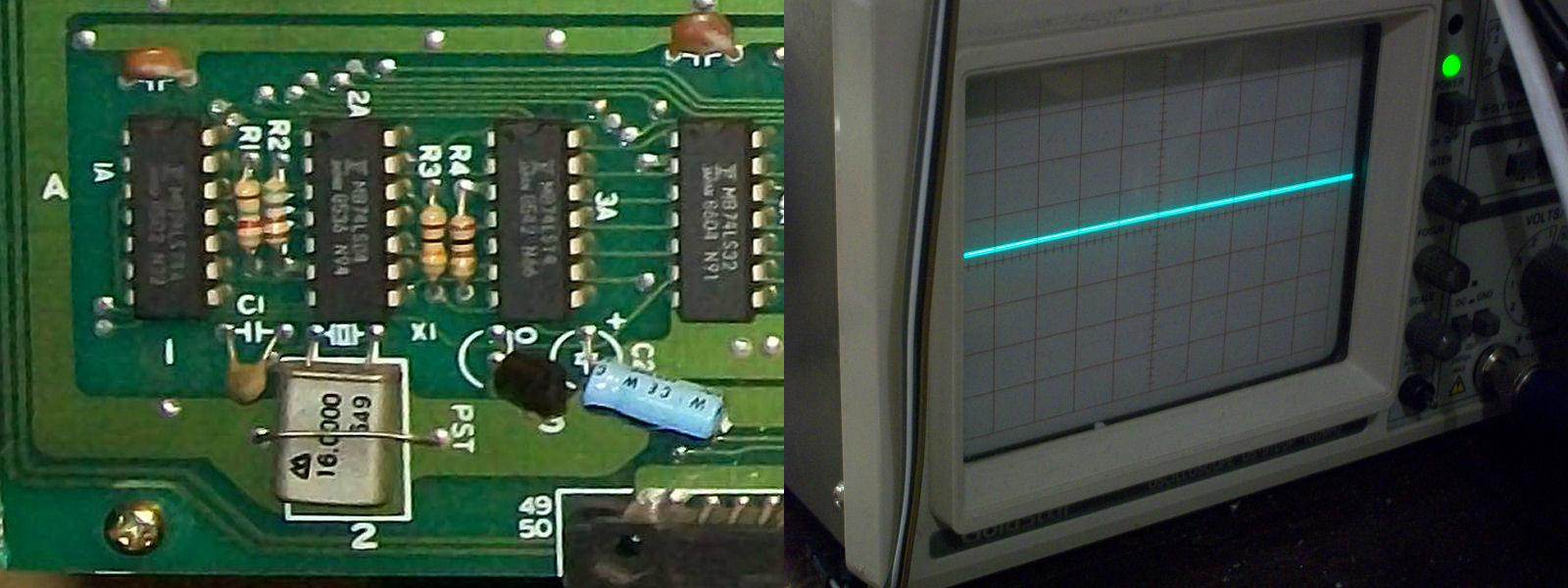
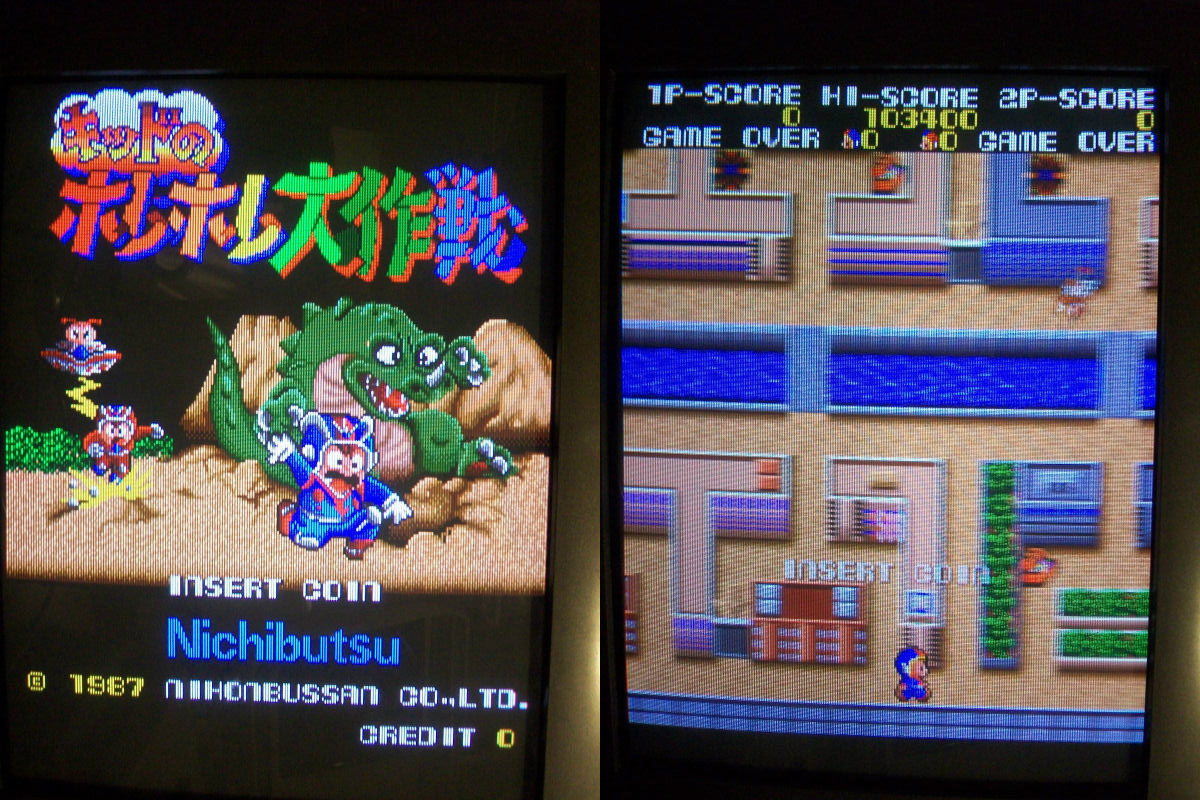
Today I manually reversed and tested the last PAL we didn’t have from the Dark Seal PCB.
The PAL in question is a PAL16R4 and is labelled TF-4 located at E12.
Xevious (Namco PCB revision) repair log
Who of us has not played at least once Xevious?
Xevious is a vertical scrolling shooter arcade game that was released by Namco in December 1982.It runs on Namco Galaga hardware. In North America, the game was manufactured and distributed by Atari.
I had on my bench the Namco version:
Board booted correctly, game was fully playable but sprites were missing some lines and also playfiled got some issues:
All GFX customs (the sprite positioner ’12XX’, the object RAM addresser ’04XX’ and the GFX data shifter and mixer ’11XX’) were OK since I swapped them with ones of my Galaga/Gaplus boards.Luckily Namco released schematics for this board so for first I checked the part of circuit involved.All was good until I come across this section:
As you can see there are six 74LS161 counters that take DATA from one 2128 SRAM @2S (addressed by the custom “04XX”):
Three 74LS161 address two of the four 2149 RAMs @5M and 5N:
When I went to probe the two 2149 RAM @5N and 5M I found four address lines (PIN3-6) stuck LOW.As I said before, these are addressed by a counter @5S so I went to use my HP10529A logic comparator on it.All led corrisponding to outputs turned ON while all inputs were correctly working.Desoldered and tested it out-of-circuit confirmed it was bad:
Fitted a good 74LS161 restored correct graphics.
With this repair we conclude the May season of logs.See you hopefully next one!
Gundhara repair log #1
Got this mint Gundhara PCB, a vertical shooter similar to Ikari Warriors, manifactured by Banpresto in 1995:
When I powered it up game was fully playable but tilemaps were totally wrong :
Before you start every troubleshooting, first thing to do is studying the hardware.MAME is a great help for every repairer with its invaluable source of information provided.In this case here is an overview of the hardware (thanks to driver developer Luca Elia):
- CPU : 68000 + [65C02] (only in the earlier games)
Custom : X1-001A X1-002A (SDIP64) Sprites
X1-001
X1-002
X1-003
X1-004 (SDIP52) Inputs
X1-005 X0-005
X1-006 X0-006
X1-007 (SDIP42) Video DAC
X1-010 (QFP80) Sound: 16 Bit PCM
X1-011 X1-012 (QFP100) Tilemaps
X1-014 Sprites?
This information pointed me in the right direction, the part of circuit to be analysed was this:
You can see on the right part of the above picture the two custom ASIC tilemaps generator marked ‘X1-012’ (QFP100 package).When I checked the one @U45 I found some lifted pins:
A simple reflow of these pins was enough to restore tilemaps:
I was declaring this board 100% fixed but while testing it I noticed something wrong in its sound, some PCM samples were played wrongly (like enemy shots) compared to good reference of MAME.Once again our beloved emulator source gave me an help to pinpoint this trouble.There is another custom ASIC which is a 16 bit PCM chip marked ‘X1-010’ (QFP80 package) in the sound circuitry @U57:
One pin was lifted, a reflow restored correct sound.
Thanks MAME!This repair log is dedicated to you! 🙂
Xevious (Namco) PAL dump added
Today, while troubleshooting a Xevious PCB (Namco board and not Atari) I dumped and reversed in GAL format the only PAL present.Original device is a not secured PAL10L8, dump has been tested working in a GAL16V8 targeting device.You can download it from our database as usually.
Konami do always great games and one of them is, indeed, The End.Manifactured by Stern electronics, it was released and licensed by Konami in the far 1977.Game itself is a mixture of Space Invaders, Galaga and Phoenix.I got this board from same previous repaired boards batch and it was really in excellent shape (I could say ‘NOS’ using an Ebay terminology) for a piece of hardware with nearly 40 years on the back:
It came with its JAMMA adapter from Konami classic pinout (-5V required), it played fine but there was no sound at all, I could only hear some faint rustles coming out from the speaker.
Digital audio circuit is made of a Z80 CPU and a AY-3-8910 sound generator.Code ROMs were good but when I probed the two 2114 RAMs I found that address line A7 was stuck high on both.Studying a bit the hardware I could figure out that Z80 addresses the two 2114 through four 7408 quadruple AND gates.And I could trace the stuck address line back to PIN6 of the 7408 @IC41 (a Mitsubishi M53208P to be exact).I probed inputs and they were toggling fine while its output was, indeed, stuck high.So, without hesitations, I desoldered and tested it out-of-circuit:
It failed miserably.Fitted a good one and I was able to restore the sound to this “aged” board.