PAL UpdatesComments Off on Volfied PAL dumps verified and converted
Nov272015
Today I could successfully verify and convert (using the PALTOGAL utility) into GAL16V8 the Volfied PAL dumps submitted some time ago by Andreas.I added proper labelling as well.So my .JED are going to replace his original PAL16L8 dumps.
PAL UpdatesComments Off on Rolling Thunder custom ‘130’ replacement board PAL dumps added
Nov232015
Yesterday I dumped and successfully reversed into GAL16V8 the two secured PAL16L8 present on a piggyback board that replaces the custom ‘130’ on an original Namco Rolling Thunder PCB.Picture of the replacement board has been uploaded to the database as well.
This is the first in hopefully a series of posts regarding the Rainbow Islands hardware.
I have no time frame in mind for releasing these posts and I will do them when I have any particular section covered.
First up is the reset/watchdog circuit.
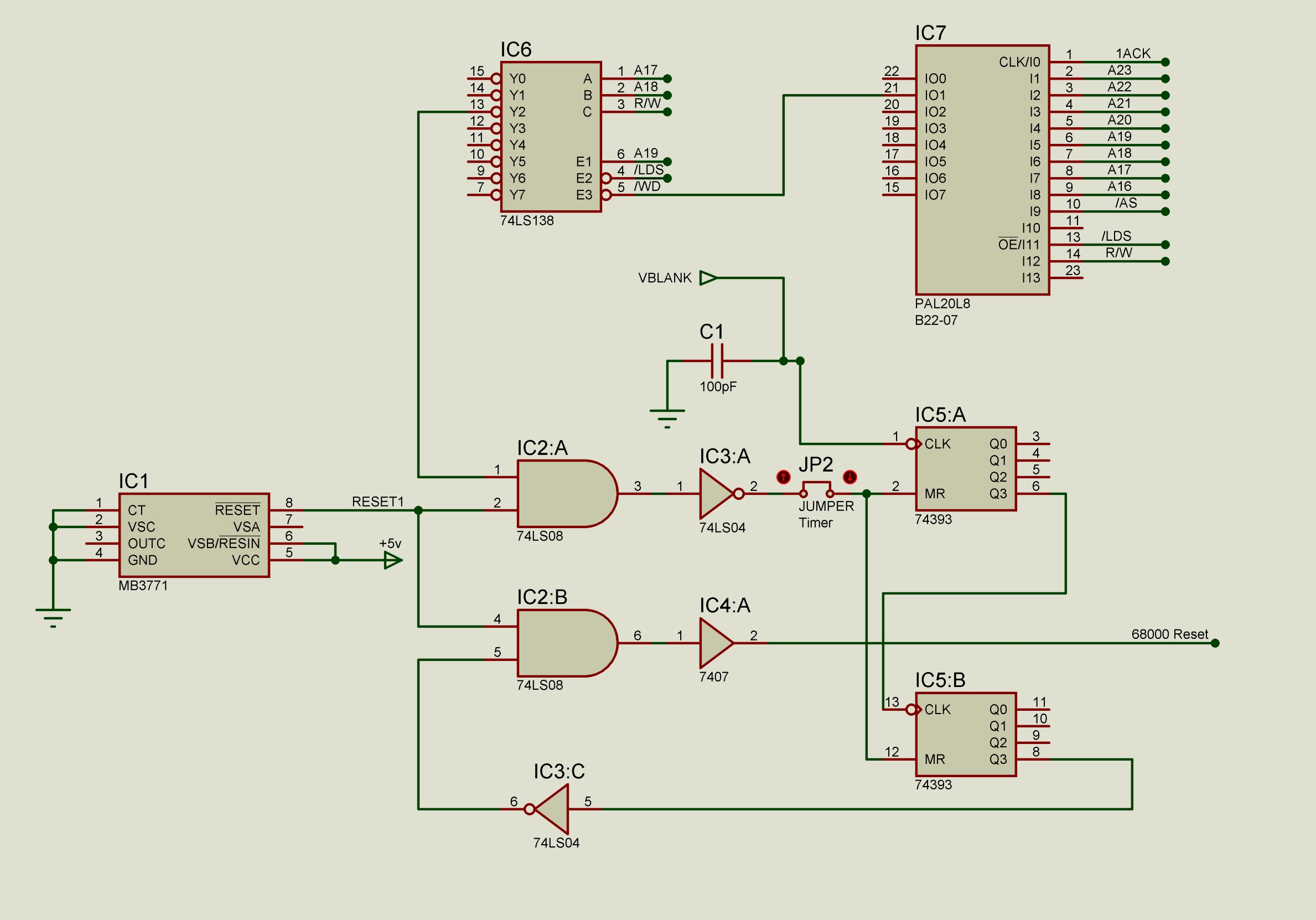
Here we have the circuit that I have drawn out.
On power up the MB3771 power supply monitor chip will keep the CPU in a reset condition by asserting a low signal to pin 4 of IC2 (74LS08 AND gate).
At the same time the master reset pin of the 74393 4-bit binary counter is held high thanks to the inverting buffer at IC3.
Note, jumper JP1 can be used to disable the watchdog although I couldn’t find a resistor tying it high which would mean if the trace was cut on JP1 the MR pin would be floating. Maybe I just cant see it.
Once the MB3771 is happy it asserts a high signal from pin 8 which will allow the 68000 CPU to run and the watchdog timer to begin.
The watchdog clock is taken from the VBLANK signal and directly clocks the first binary counter at pin 1 which in turn clocks the secondary binary counter via output pin 6.
If the master reset pin in not activated within a certain time then the counters will count up and initiate a reset.
The watchdog reset signal is achieved by writing any value to an address between $3c0000 – $3dffff.
The memory map for the watchdog is determined by the PAL20L8 device B22-07 @ IC7.
Output pin 21 is the pin concerned with this function. Here are the equations for it.
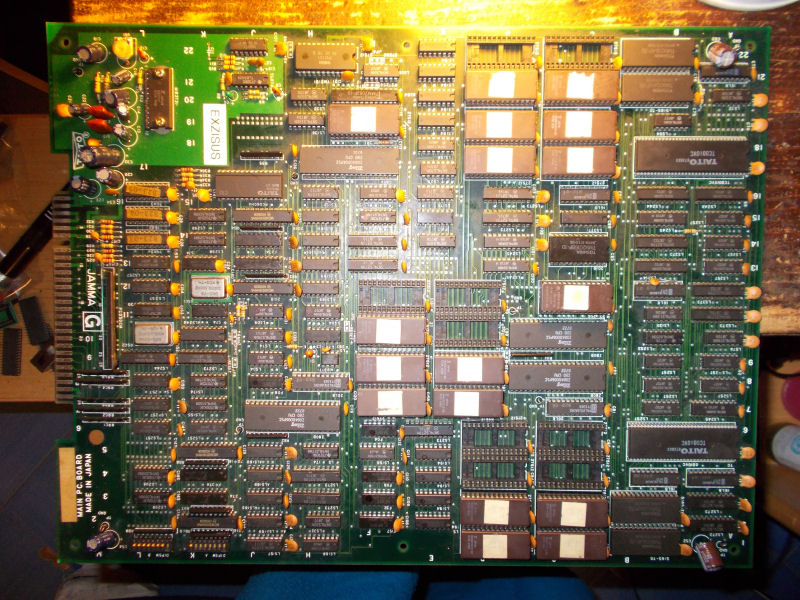
I bought this pretty rare Exzisus PCB as faulty from our member Corrado:
For the uninitiated it’s horizontal scrolling shooter arcade game released by Taito Corporation in 1987.There are two PCB version, one not JAMMA with separate RGB outputs for background and sprites, the other with a single video outputs and is JAMMA compliant.The one I got was the latter.
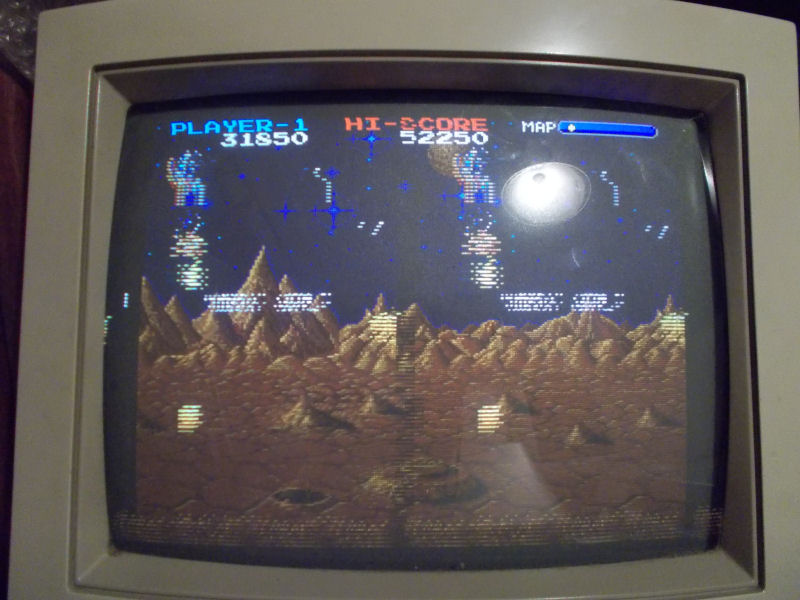
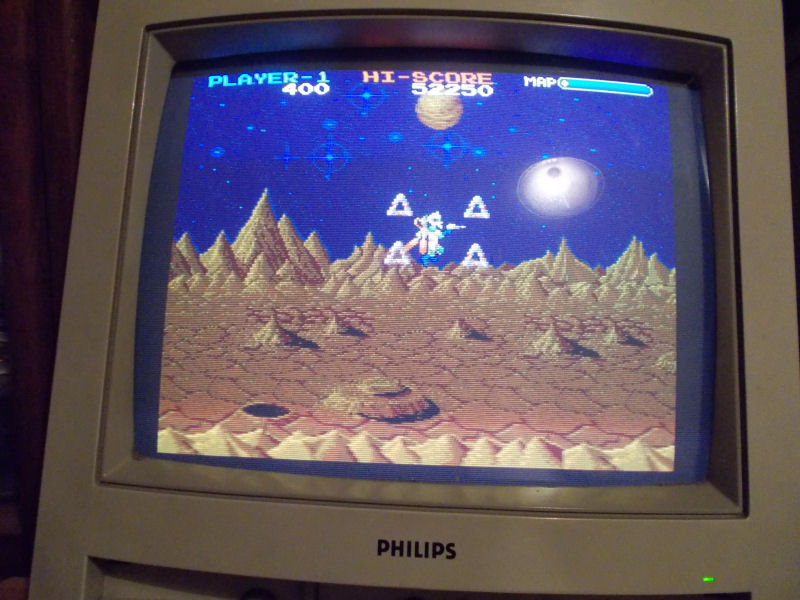
Once powered the board up I immediately noticed two issues : all sprites were horizontal lines shifted and repeated on each half of screen :
and sound was missing at all (although I could hear some noises sign that amplifier was good).Studying a bit the hardware, I could figure out how sprites were drawed.The four sprite EPROMS are addressed by a custom, marked ‘TC0010VC’ (there is another one for the backgrounds) while the data were written on two 6116 RAMs which were addressed by the same custom but not directly but through two 74LS273 latches and four 74ALS169 counters:
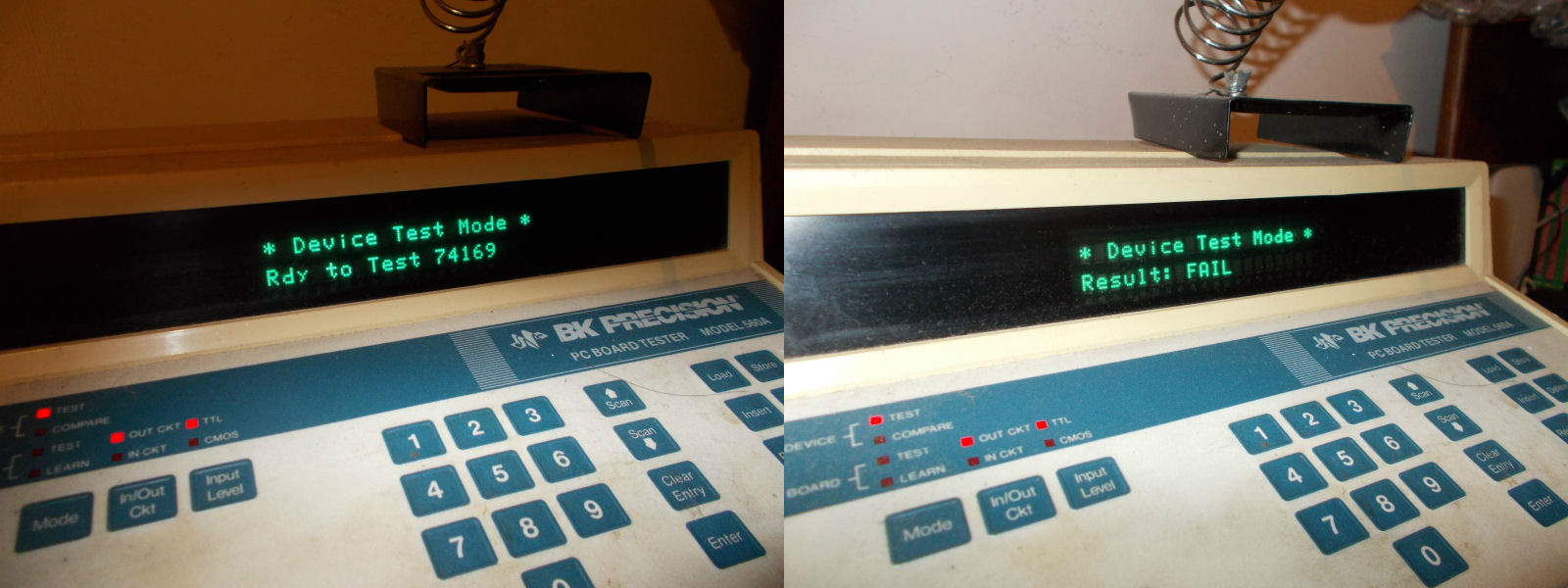
Probing the latter with my logic comparator I got troubles on the outputs of three of them so, although false readings are quite common for this kind of device I decided to remove them.Tested in my BK560A they all failed:
Once replaced these counters, the sprites were correctly restored:
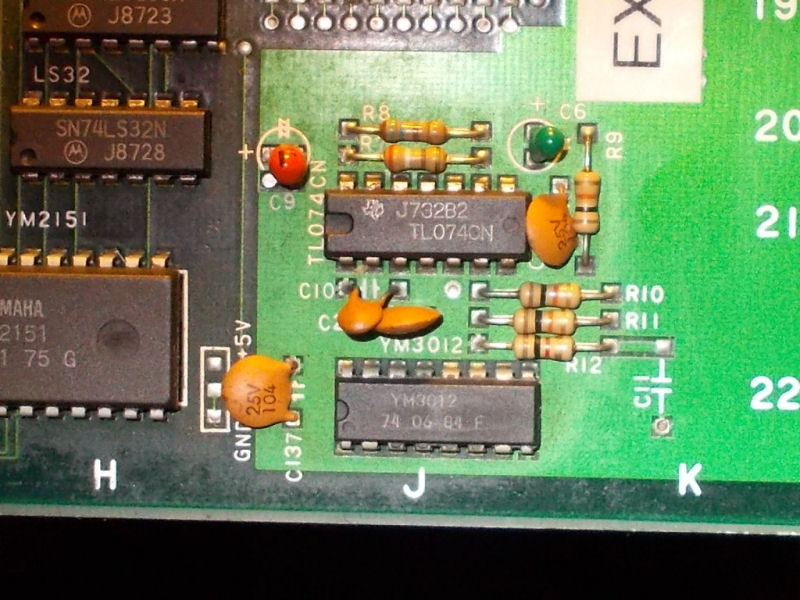
So I could focus on the sound lack.Connecting an external amplifier to the analog output of the YM3012 DAC I could hear all the sound as well as on the input of the near TL074CN OP-AMP but nothing on its output :
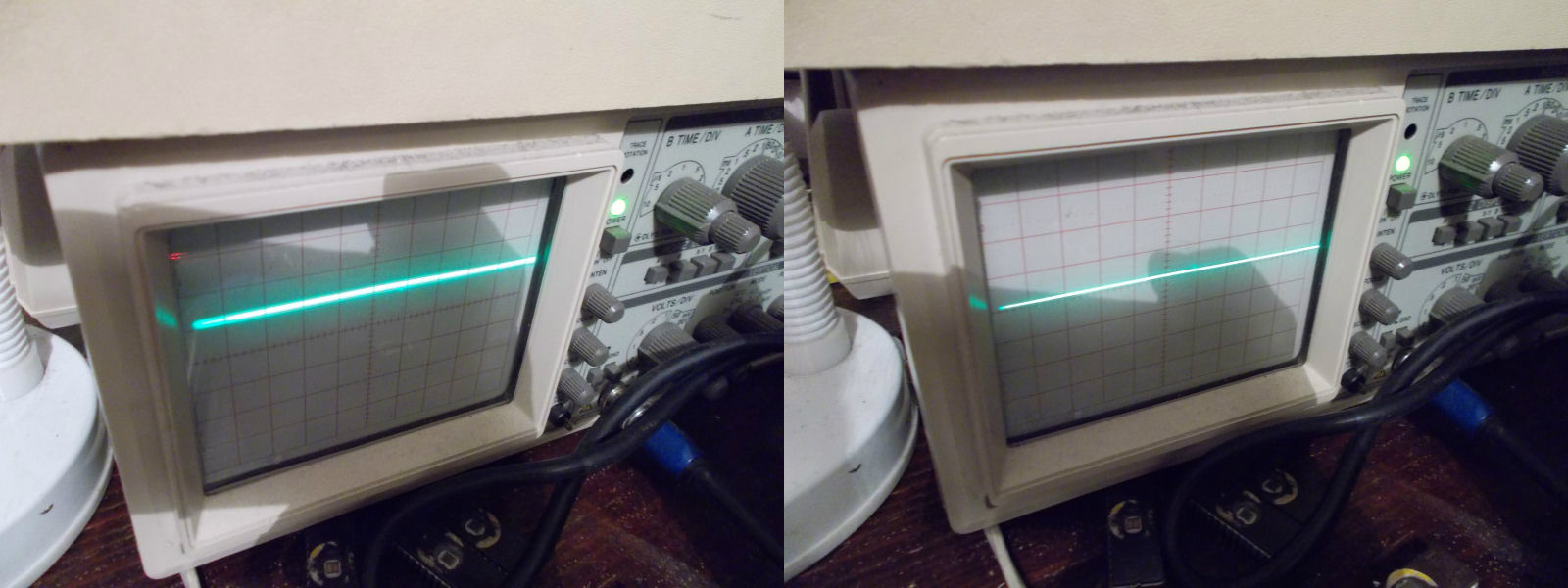
This was confimed also on my analog scope (good input on the left, no output on the right):
Fitted a new TL074CN @J21 restored full sound.End of job.
PAL UpdatesComments Off on Thunder Hoop PAL dumps added
Nov202015
Today I’ve dumped the PALs from an original Thunder Hoop PCB (a weird and funny platform game by Gaelco).Devices were four unsecured GALs (two GAL16V8A and two GAL20V8A) so I could read them in a normal programmer and successfully test dumps back on board.