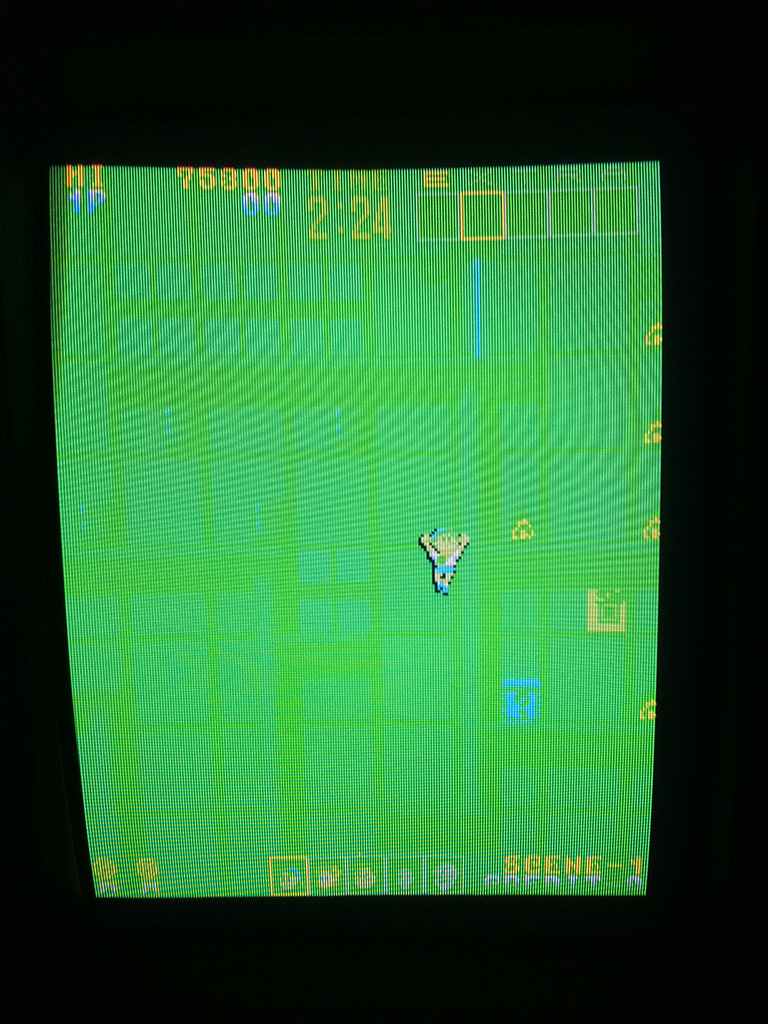
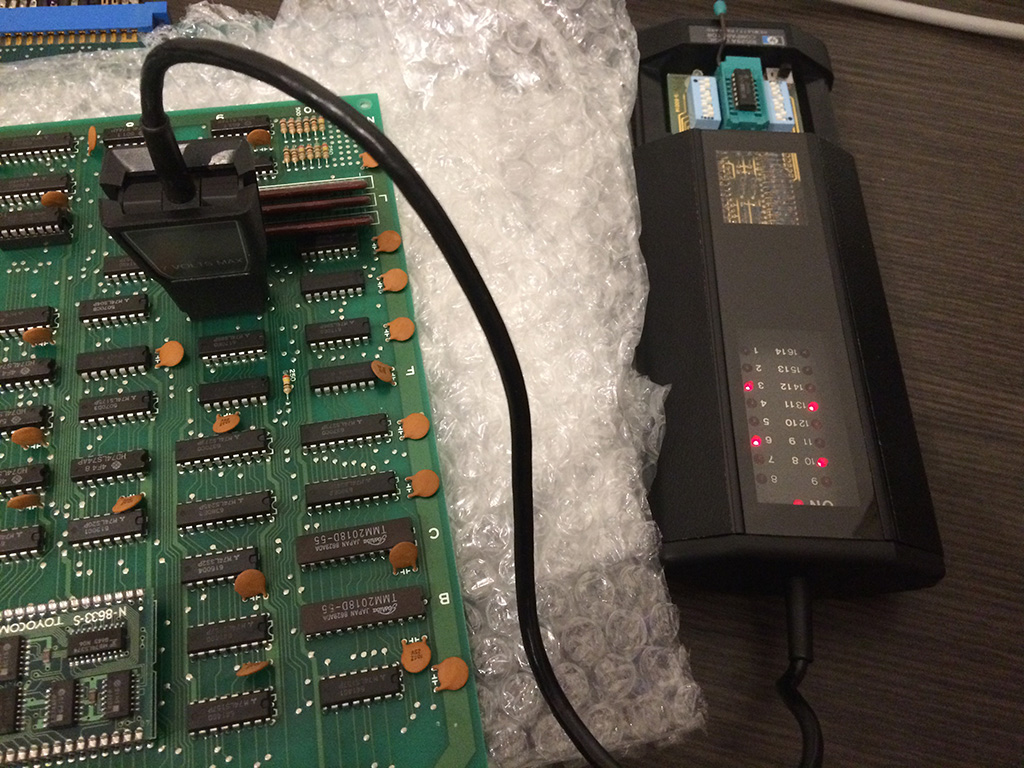
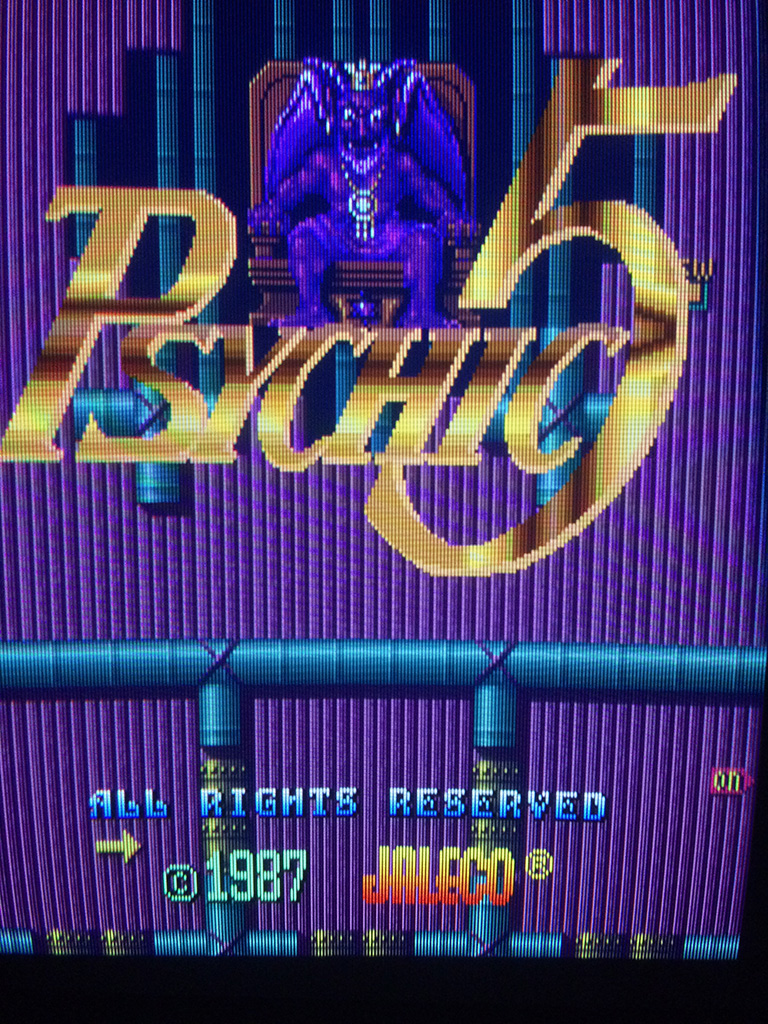
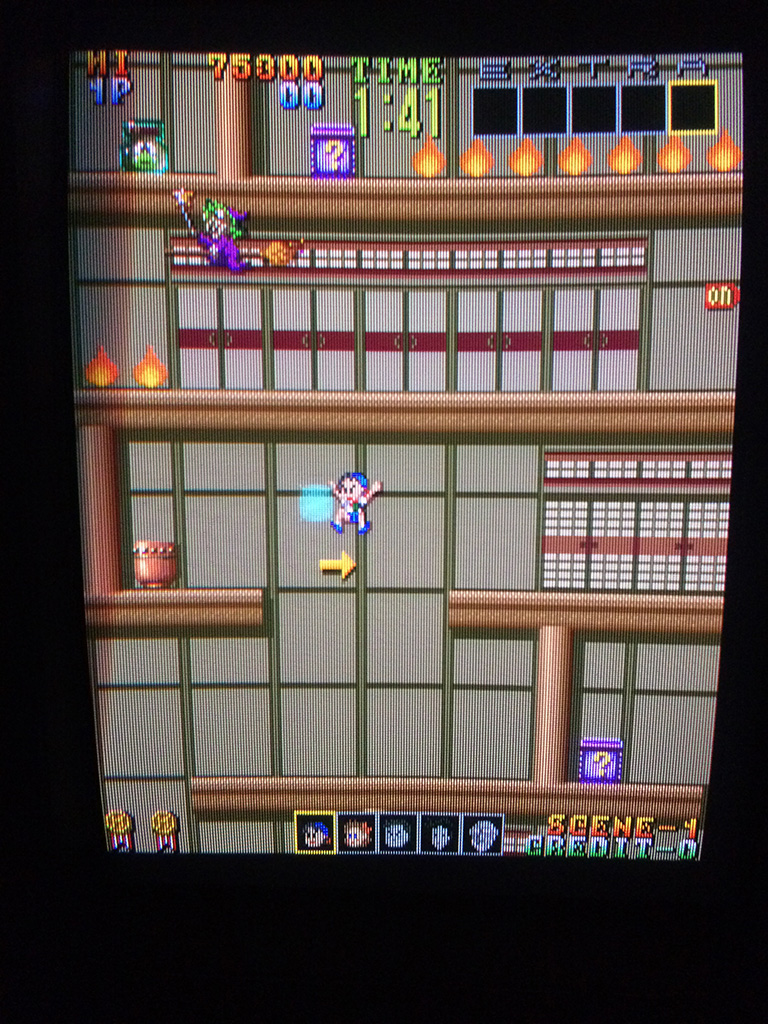
Today I dumped the two PALs from a Gaiapolis (single board PCB revision).Now we have dumps from both PCB versions as this game come salso in a two boards revision which share only a PAL (the one marked ‘055996’ @8G) while the other one (marked ‘056469’ @22G and already in database) has slightly different equations from the one I dumped today ( which is marked ‘056469A’).Dumps have been successfully tested onto GAL16V8 targeting devices.
Dangun Feveron repair log
More than a repair a quick fix.
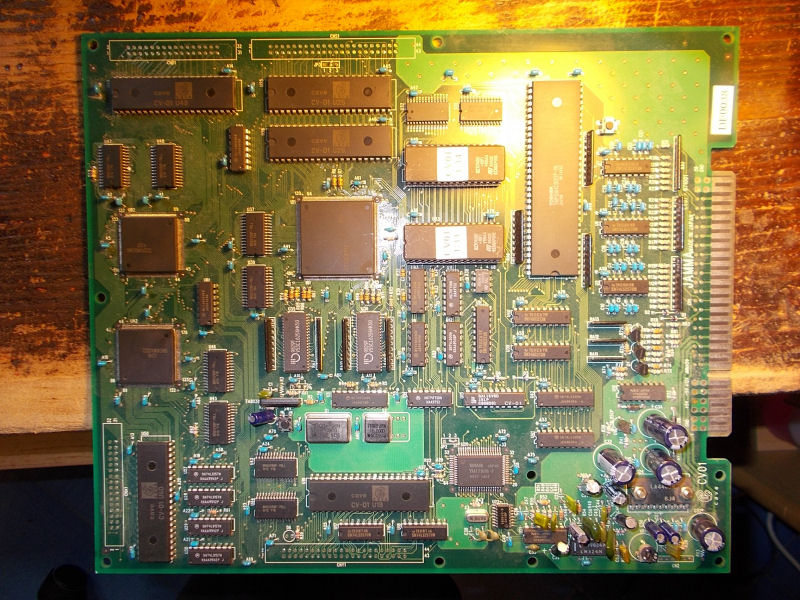
I got this Dangun Feveron PCB :

The owner said that most of sprites were scrambled and I could confirm the issue upon powered up the board:
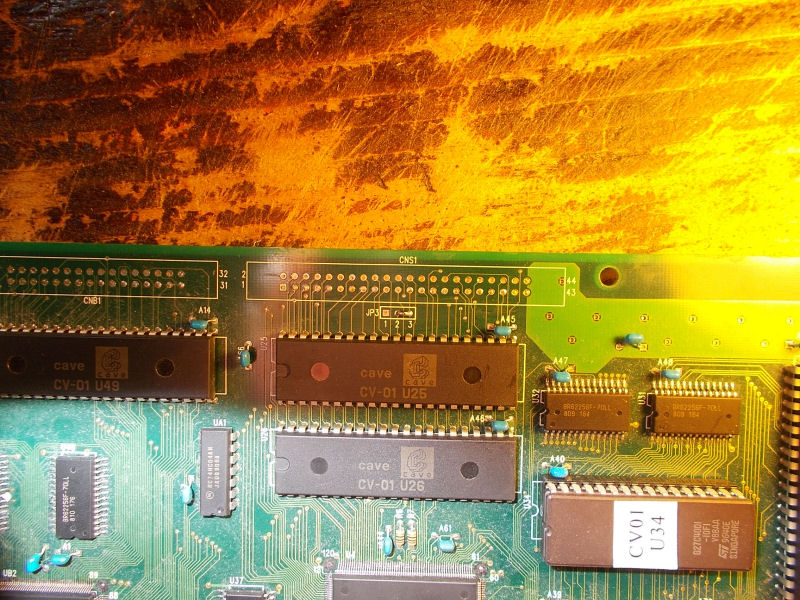
Sprites data are stored into two 42 pin 32Mbit MASK ROMs @U25-U26:
![]()
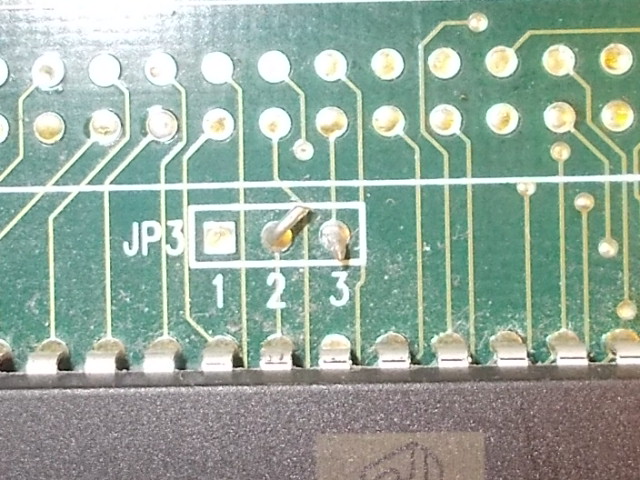
When I went to probe them I noticed a broken jumper @JP3:

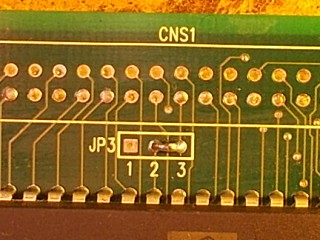
Checking with a multimeter the connections of this jumper relevealed that point ‘2’ was connected to pin 32 of the two MASKs ROMs, therefore the higher address line A20.So, signal coming from point ‘3’ was not reaching this pin due this broken jumper and this caused the sprites issue.Once restored it:

all came back to normality.End of job.
Received this Batsugun Special Ver. PCB for a repair:

Game played fine but colors were all dull and washed-out, take a look at this comparison with a MAME snapshot on the left:

or this video:
This was a clear sign of some troubles in colors palette circuitry.After studying the hardware, I was able to locate this section by shortcircuting some address/data lines of two CXK5816 SRAMs @U39 and U40 and at the same time observing color changes on screen:

Besides the two mentioned SRAMs, you can see some 74LS245 and two 74HC273 involved in data bus (the first ones in exchanging data from/to the two RAMs, the latter in latching).When I went to probe the two 74HC273 I found that input pin 13 of the one @U43 was stuck low and its corresponding output pin 12 showed only weak signals:

So confident I went to remove it:

When I tested it out-of-circuit it failed:

Once fitted a good IC and powered up again the board, the game played great with no further issues.

End of job.
There are not only PALs on our beloved PCBs but also bipolar PROMs!
A bipolar ROM or briefly BPROM (“BIPOLAR” stands for the transistor technology used in the manufacturing process) is a OTP memory device, which can be programmed just once and hence the data programmed can never be erased.They were used for various tasks: address decoding, state machines, and video colour palettes, for example.Like every electronic part they can fail and nowadays obtaining a blank device is really hard and expensive.And even if you find it, your EPROM programmer probably doesn’t support BPROMs as they are obsolete parts.
Someone replace them with EPROMs mounted in a custom adapter but we chose GAL devices as replacement since most of times there is no need of adaptation (if you program them in the right way, obviously).Besides, GAL devices are really common and inexpensive.Last but not the least, they can have fast access times like BPROMs require.So,today we open a new archive for GAL replacements of bipolar PROMs, you can find it under the menu ‘PLD Archive’ on main page.I hope you will enjoy it and contribute to its growth.
Sega System 1 PAL update
Today we have some new PAL dumps from Sega System 1 hardware.
Thanks to the work of ‘Tirino73’ and ‘f205v’ :
https://www.citylan.it/wiki/index.php/Wonder_Boy_(set_3_bootleg_2)
we have dump of the unsecured PAL16R4 @IC 67, I converted it to GAL16V8 and successfully tested on my bootleg boards.Silvio Grazini confirmed that it works also on original hardware.So now set is complete along with the dump of the other PAL16R4 @IC41 already in our database.
Besides, they dumped also the devices (a PAL16L8 and a PAL16R4) on the piggyback board, I converted them to GAL16V8 and successfully tested on my boards.
Thanks again to them all.