Gaiapolis & Metamorphic Force repair log (a.k.a Konami ‘054573″ color DAC reworking)

 PCB Repair Logs, Repair Logs  Comments Off on Gaiapolis & Metamorphic Force repair log (a.k.a Konami ‘054573″ color DAC reworking)
Jun 302015
 

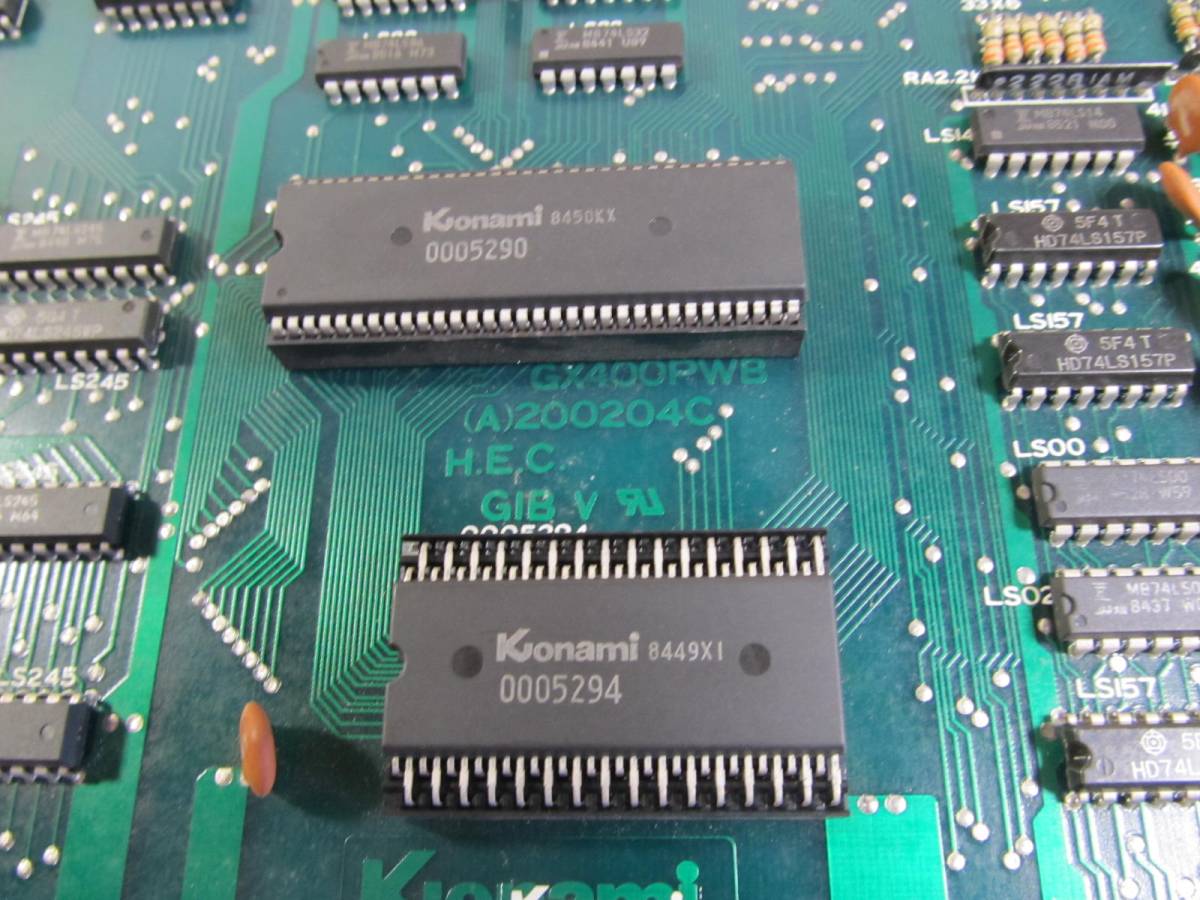
As every arcade fan/collector probably knows, Konami makes great things but… sometimes weird.Technically speaking every their board (starting from old ones like Gyruss to latest ones ) has its own hardware layout which involves the use of  custom ASICs (Application Specific Integrated Circuit).These ICs are used to semplify the layout and prevent board bootleging.They can have most disparate shape and package and do various functions (sound, graphics, I/O and so on).In particular the Konami ones are really well made but often prone to failure.Some example of their customs :
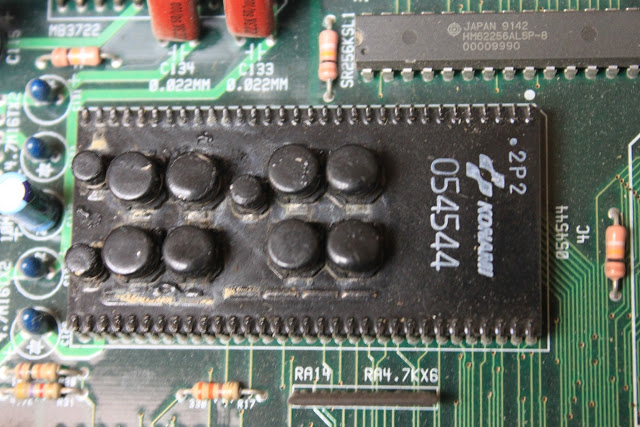


The one I faced during this double repair log is the one marked ‘054573″ .It’s used on hardware of mid ’90s, it has SIL 15PIN package and it’s essentially a color DAC, it converts digital color signal into an analog one outputting it directly on JAMMA connector (so one IC is used for each RGB colors) :
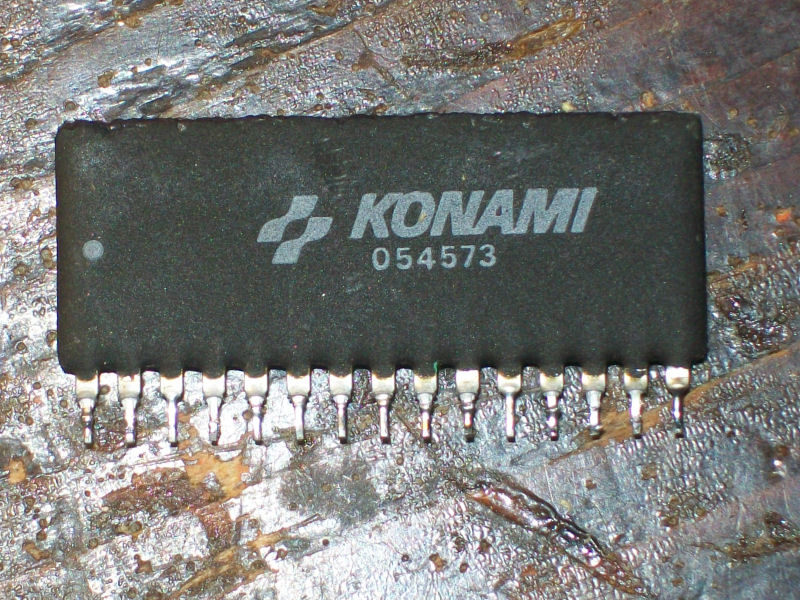
Konami_054573

Here is the IC ‘naked” , picture kindly provided by IronGiant:
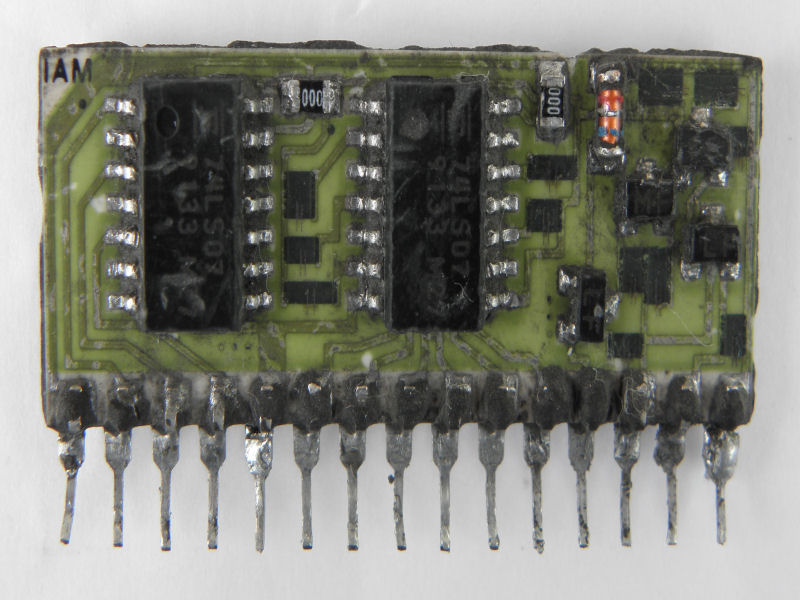
054573_800X600

It’s a quite fragile part, indeed while I was testing a Gaiapolis PCB, I switch it OFF/ON and I got this (picture on the right) :
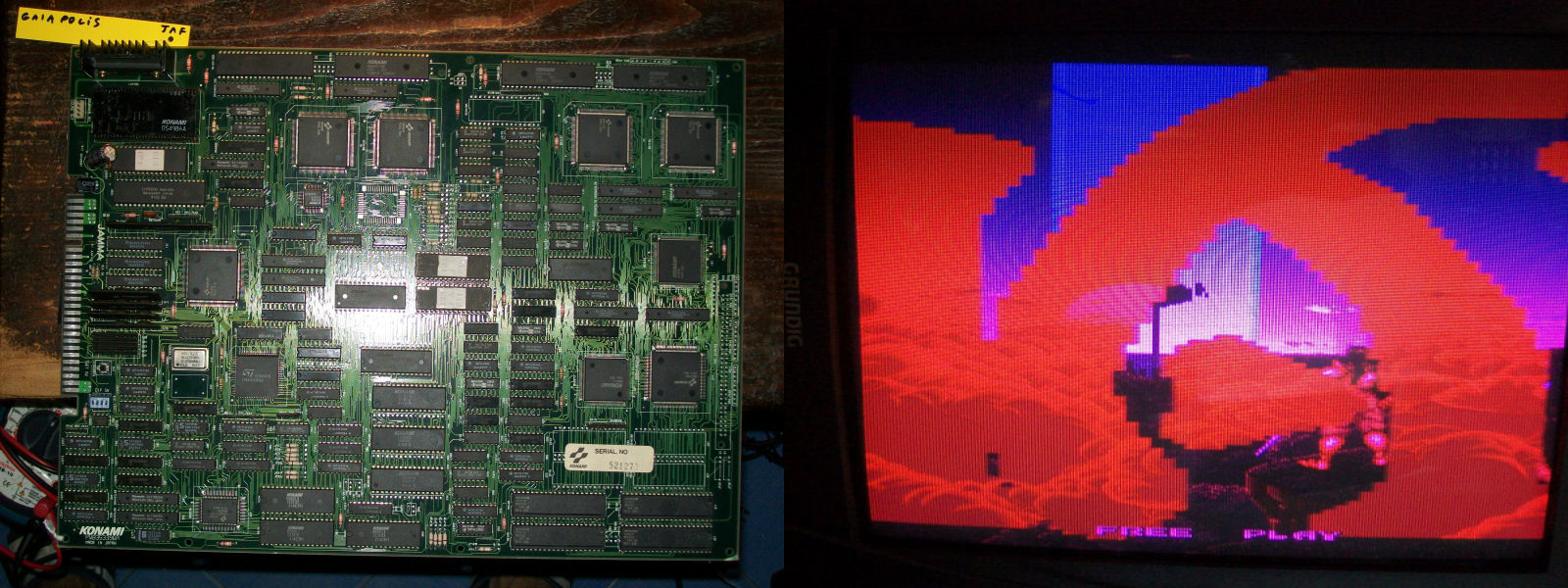
gaiapolis_issue_1

Green color was suddenly missing.Once identifying the ‘054573’ DAC responsible of this color I compared with a logic probe its pins to  the ones of the other two DACs and they had exactly the same activity except for PIN2 which is , indeed, the output connected to PIN12 solderside of the JAMMA edge.Observed with an analog scope confirmed the output was silent compared to an healthy one of a good DAC:
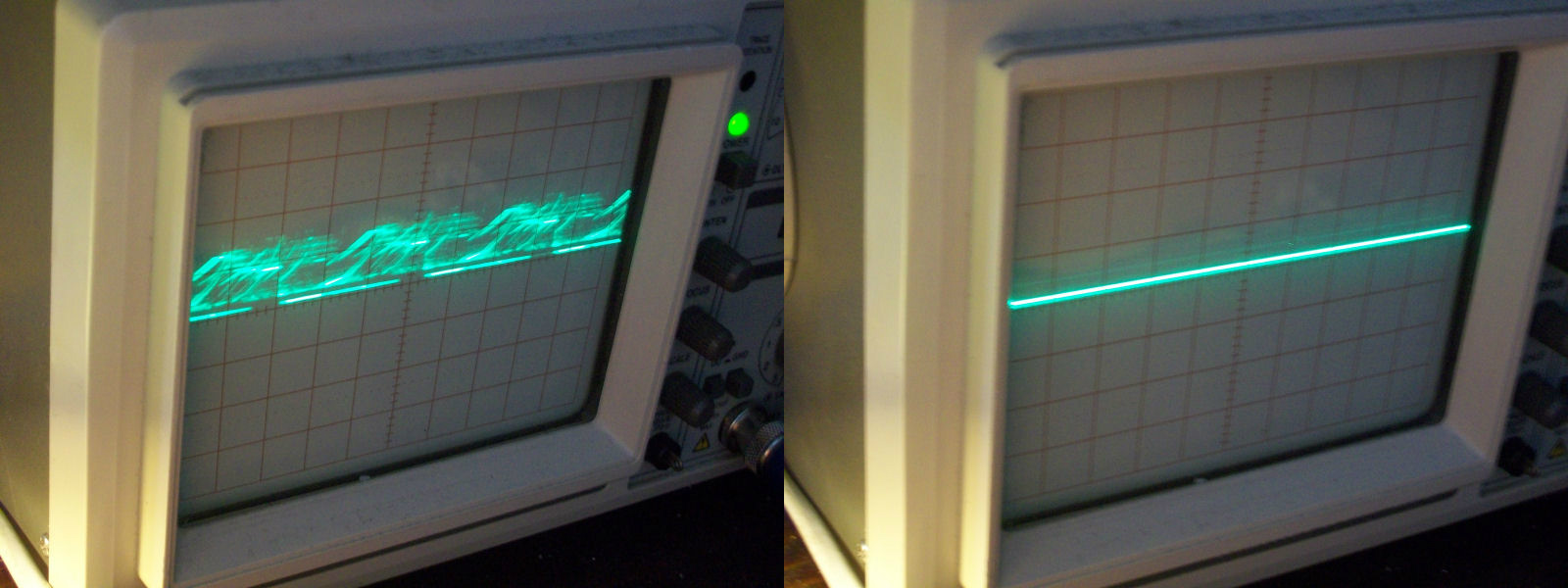
output_comparison

Replaced it and the green color was restored :
green_fixed

The second PCB, a Metamorphic Force one which also use this kind of DAC, was perfectly working but someone made an awful job on the solderside, “piggybacking” a good ‘054573’ DAC on the faulty one (the green color one also here) and fixing it with hot glue:
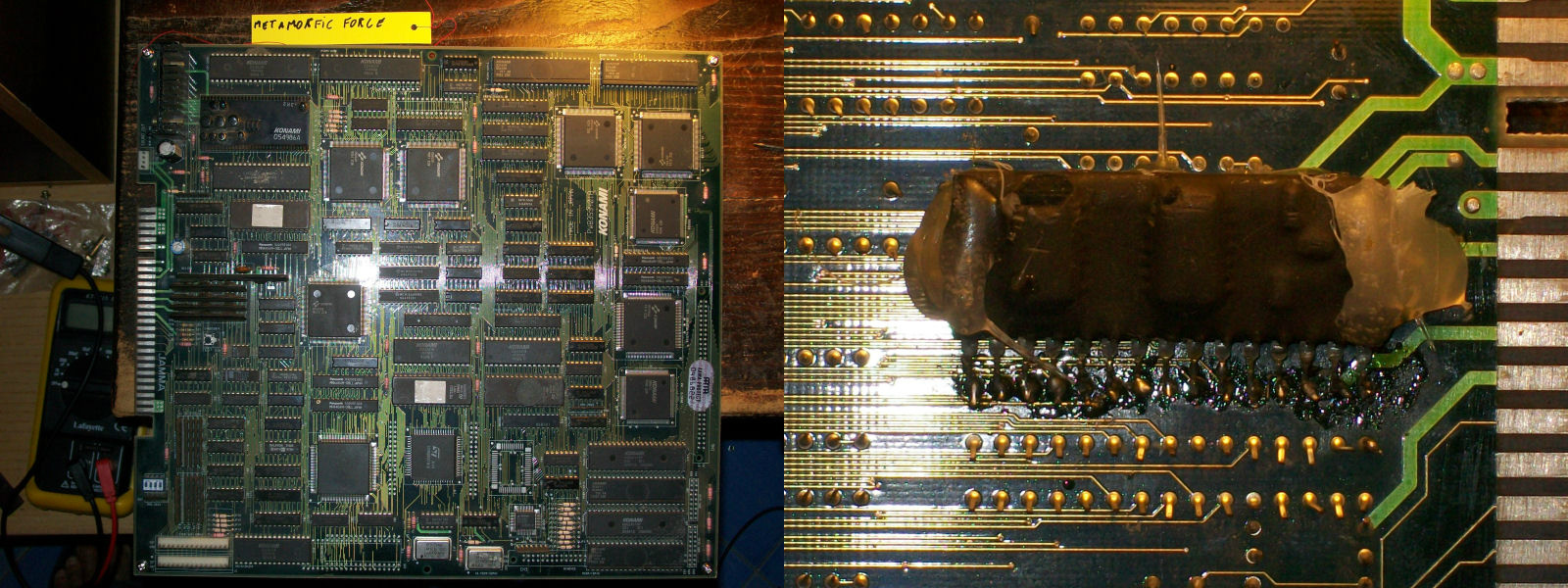
metamorphic_force_reworking

Since the eye wants its part, I decided to revert this orrible hack restoring the original status and testing successfully the board :
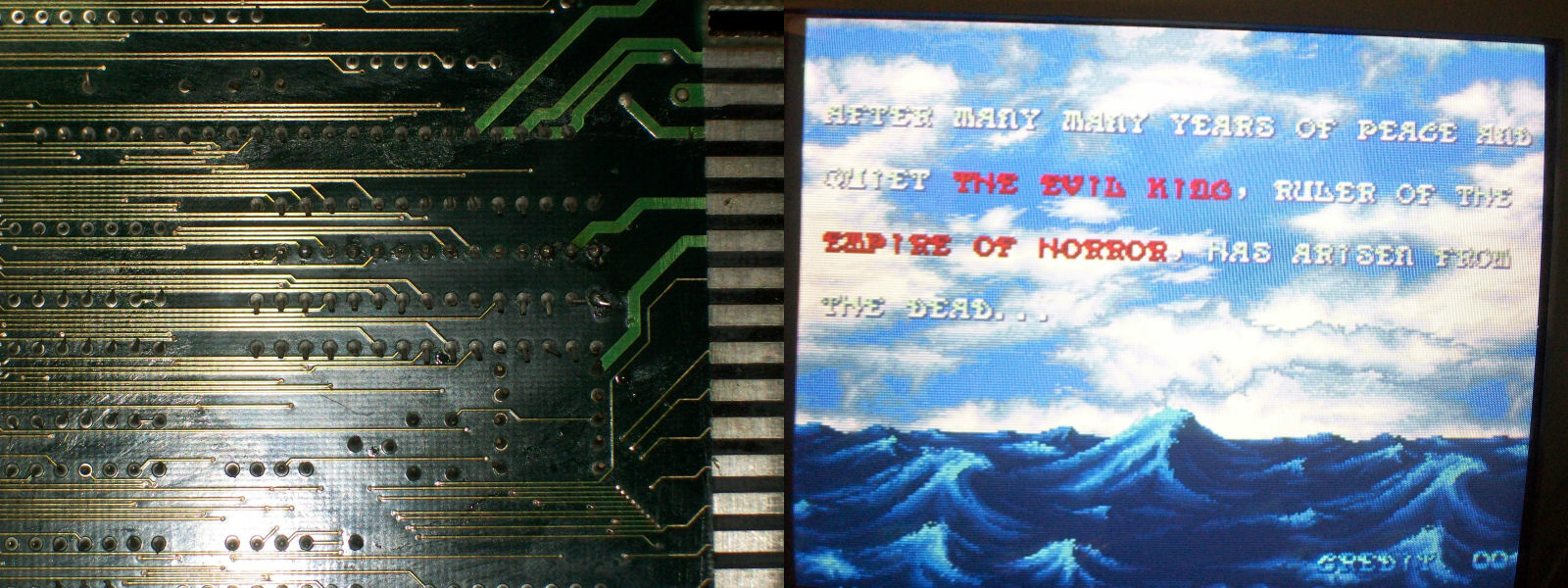
job_done

Konami does great but weird things always, remember! 🙂
 Posted by at 3:16 pm
Jun 242015
 

Got this pcb from ebay marked with “cracking sound problems”

The game sounded like an old LP with a lot of scratches and missed some sounds.

On this board, the YM2610 handle FM synthesis and PCM samples.

Given the fact that it is very difficult that the sound chip will fail, I started to probe the smd stereo DAC YM3016.

I could hear the same cracked sound coming out and I was sure that changing it would fix the issues.

I found a donor board and soldered a new DAC.


Foto 16-05-15 10 49 00

Retested the pcb and same problems.

At this time I was quite sure that the sound chip itself was broken.

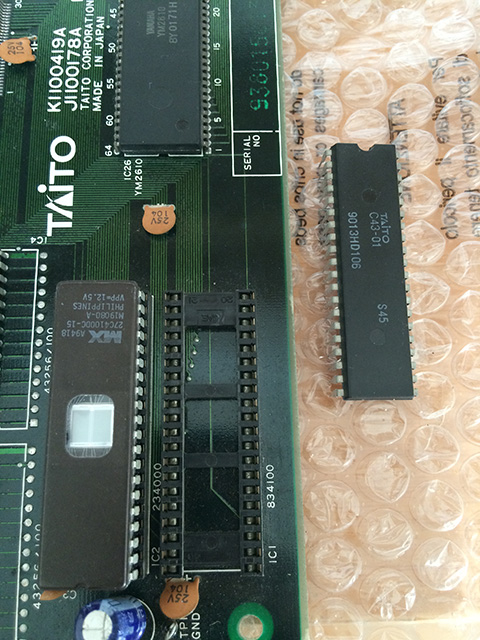
Suddendly I remembered the most obvious thing to test first: the sound rom C43-01!

It was a maskrom….marked Taito….they had the most unreliable supplier ever.

In the past, I found many Taito maskroms which caused gfx faults because of internal faults.

After cheking the maskrom on my eprom programmer one pin was not making contact and it was clear that is was an internal break.

Burning a 4mbit eprom with maskrom pinout (like a 27c4100) restored the sound.


Foto 16-05-15 10 49 31

Robocop 2 repair log

 PCB Repair Logs, Repair Logs  Comments Off on Robocop 2 repair log
Jun 242015
 

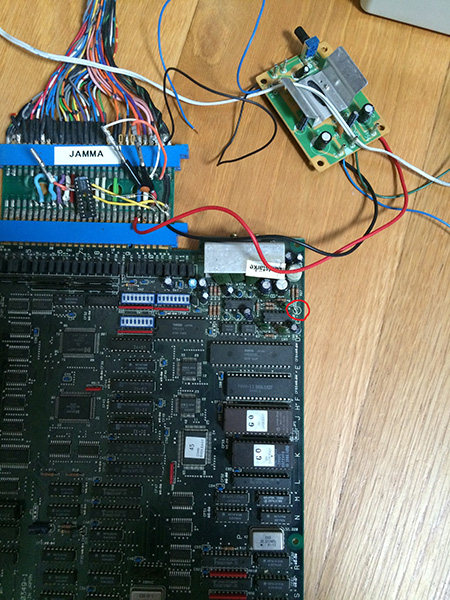
The game was working fine but you could hear only the sound fx, not the music.

Usually these kind of issues are related to either the DAC or the operational amplifier connected to the FM sound chip.

I used my external amplifier to probe the output of an operation amplifier and I could hear perfectly the music.

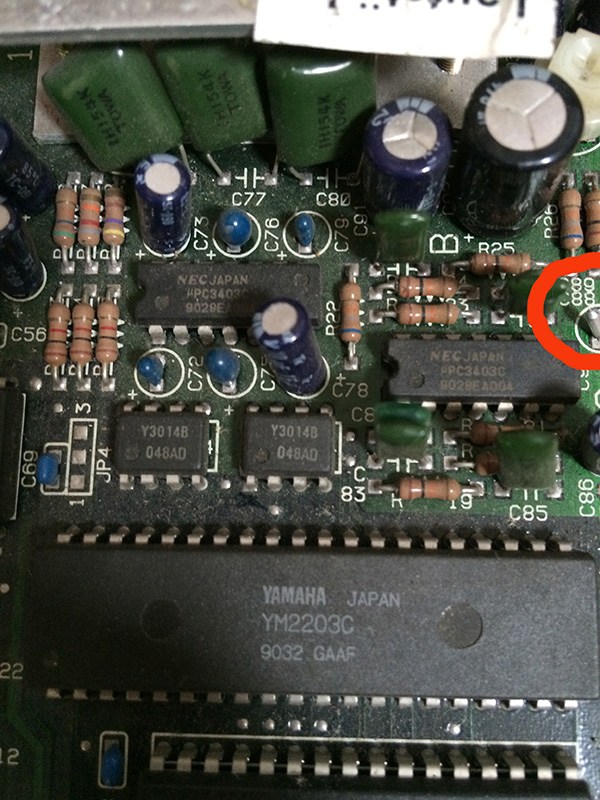
After checking for interrupted lines I noticed a missing cap.

Bridging the two pins restored the music.

Easy job!

Foto 15-05-15 18 02 59


Foto 15-05-15 18 02 49

Kyohkoh-Toppa (BreakThru) repair log

 PCB Repair Logs, Repair Logs  Comments Off on Kyohkoh-Toppa (BreakThru) repair log
Jun 232015
 

Maybe the name “Kyohkoh-Toppa” doesn’t say anything to most of arcade collectors/fans but if ,instead,I said “BreakThru” many of you will remember a game whose goal is to drive a dune buggy to “breakthru” the enemy lines of five different areas.So, for those who still have not understood, “Kyohkoh-Toppa” is the japanese version of BreakThru released  by Data East in February 1986 for the eastern market.

Here is the PCB:

Kyohkoh-Toppa_PCB

Board booted fine but it had a graphic issue since sprites were missing some lines:

sprite_issue

I noticed that problem went away if I flexed the board so there was some poor contact somewhere.In this kind of hardware all the graphics is generated in the bottom board so I reached it and found this:

2018_600MIL_adapted

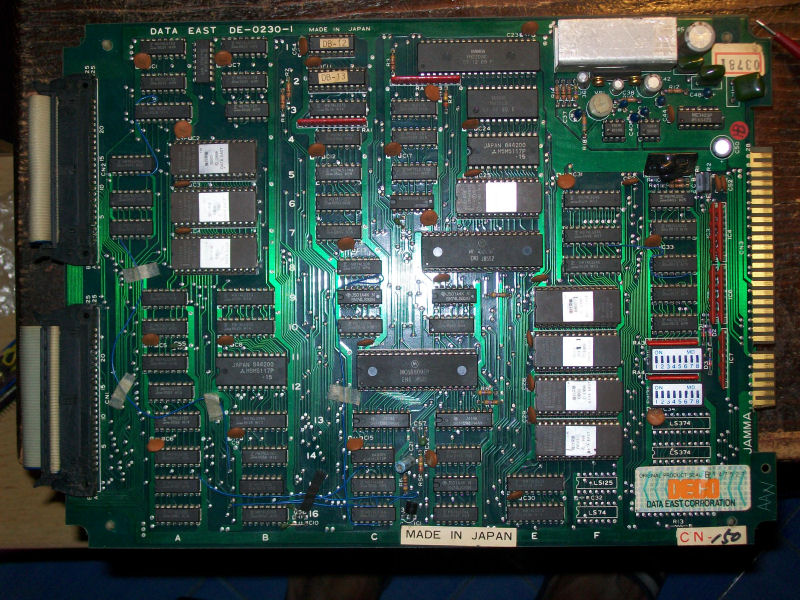
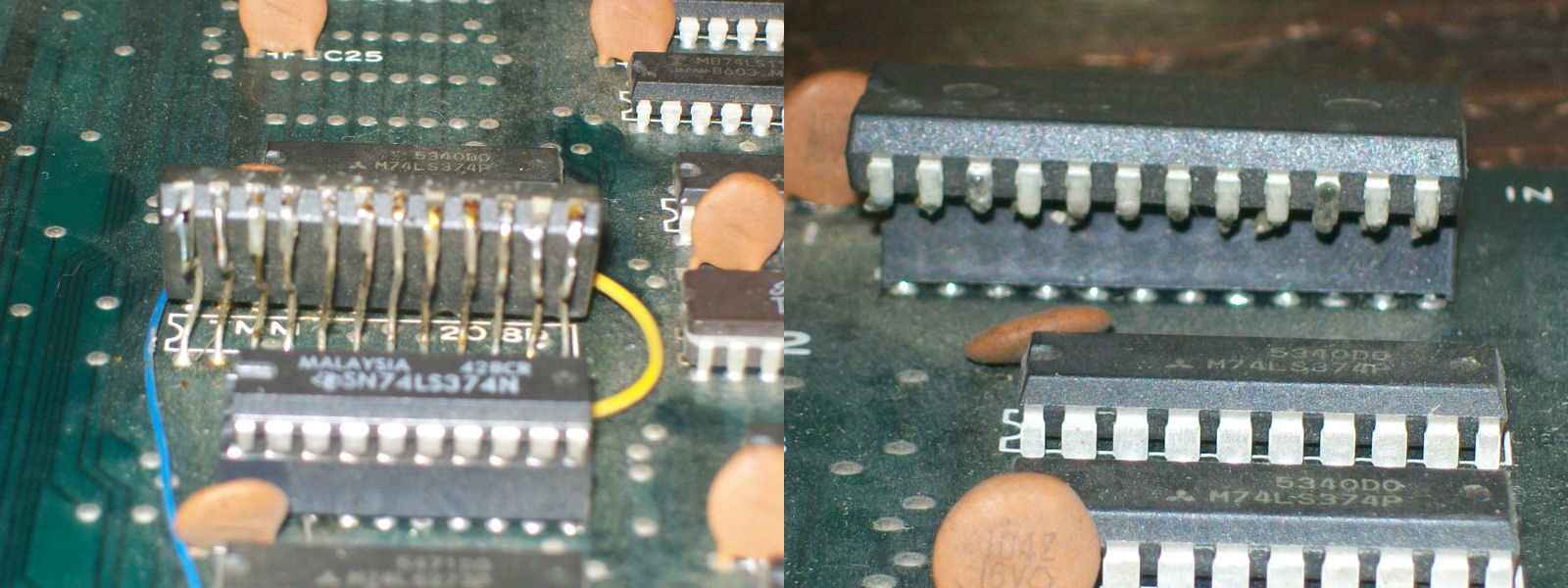
Someone (certainly not manufacturer) replaced two TMM2018 300-MIL SRAMs with two 600-MIL equivalent ones adapting them in narrow sockets!For a better understanding of the package dimensions:

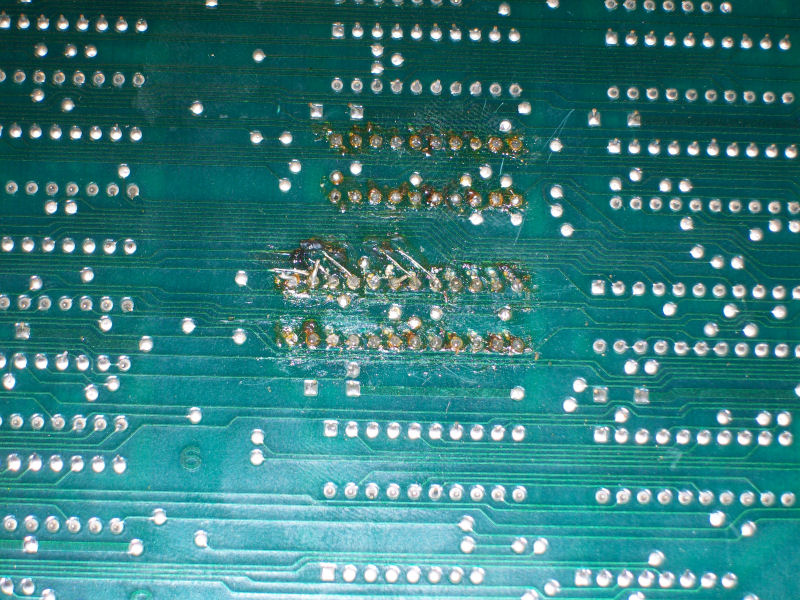
Not a neat job, for sure…Anyway, I could pinpoint sprites issue in the SRAM @11E (the one of the left picture) since problem was cleared when I pressed it.As you can see from picture they used some jumper wires on part side while patched some broken tracks on solder side :

broken_tracks_solderside

So, I decided to remove this hack, check that all the RAM connections were fine and use a proper 300-MIL chip in a new socket :

socket_job

In this way sprites were stably restored and board 100% fixed.

sprites_restored

 Posted by at 11:12 pm

Nova 2001 repair log #2

 PCB Repair Logs, Repair Logs  Comments Off on Nova 2001 repair log #2
Jun 232015
 

Another Nova 2001 repair log here after the one from Corrado.Here is the “patient” on the operating table today:

Nova_2001_PCB

PCB was sent me flagged as “SOUND ERROR”, indeed when I fired it up, the music and sound FXs were only noises.Here is a record for a better understanding of what I mean:

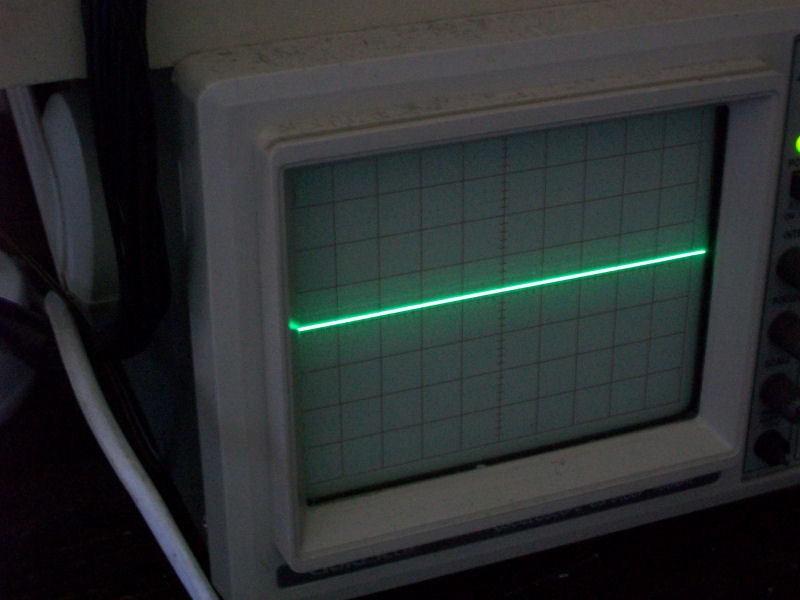
All sound/FXs are generated by two AY-3-8910 chips so I went to probe them  and found no activity on all their pins.This was due a missing clock on PIN22 of both (signal is shared) as shown on analog scope:

missing_clock_PIN22

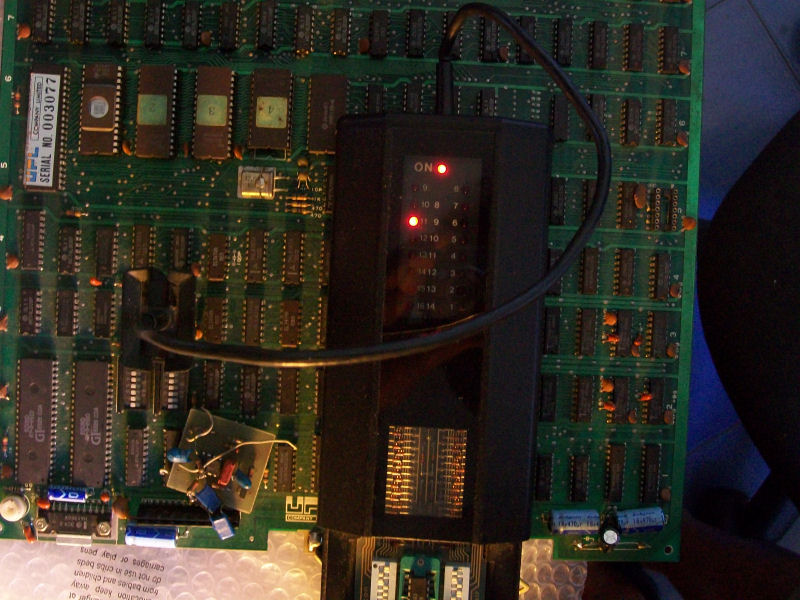
I could trace the CLOCK signal back to PIN9 of a 7474 @3E and comparing the chip with a good reference one using with my HP10529A confirmed trouble on this output:

7474@E3_comparing

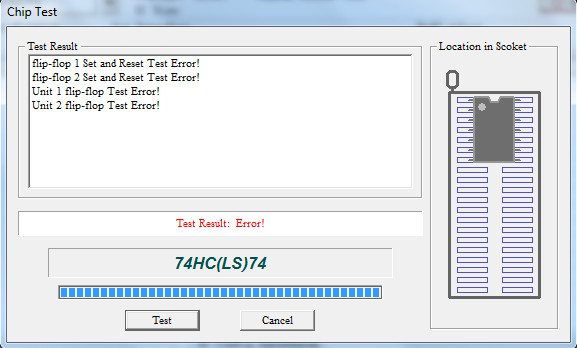
It failed miserably when tested out-of-circuit:

7474@3E_failed

Mission accomplished, another arcade PCB preserved!


 Posted by at 8:51 pm