Juno First repair log #3

 PCB Repair Logs, Repair Logs  Comments Off on Juno First repair log #3
Jun 262014
 

Third repair log from the batch of Juno First boards.
On power up the board was completely dead. No clocks were present on the CPU or many other IC’s.
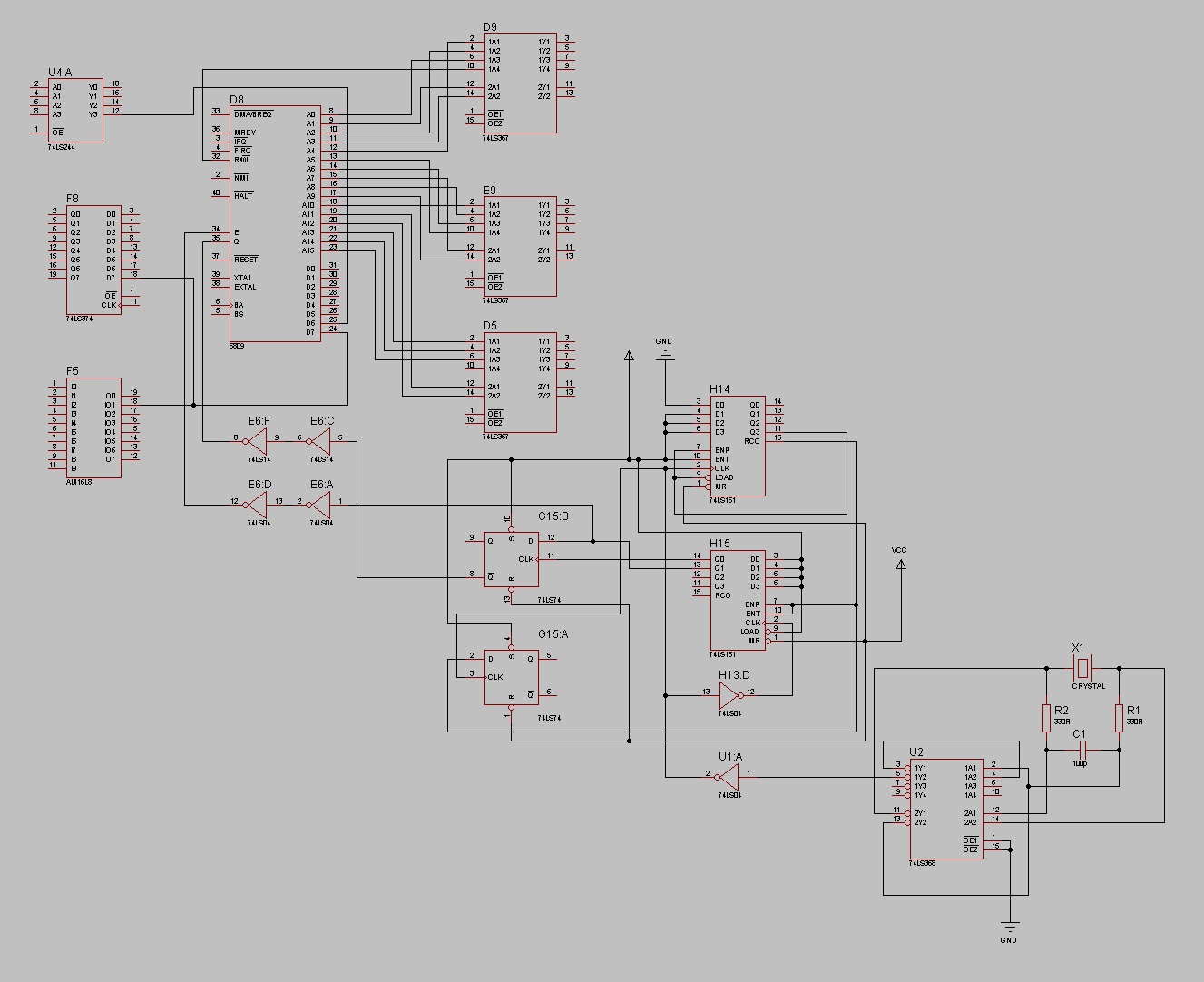
As this is a bootleg board the available schematics do not fully apply and the clock circuit is normally handled by custom chips so this was a bit of a learning experience.
To help in dealing with this problem I started making my own schematics up.
junobl

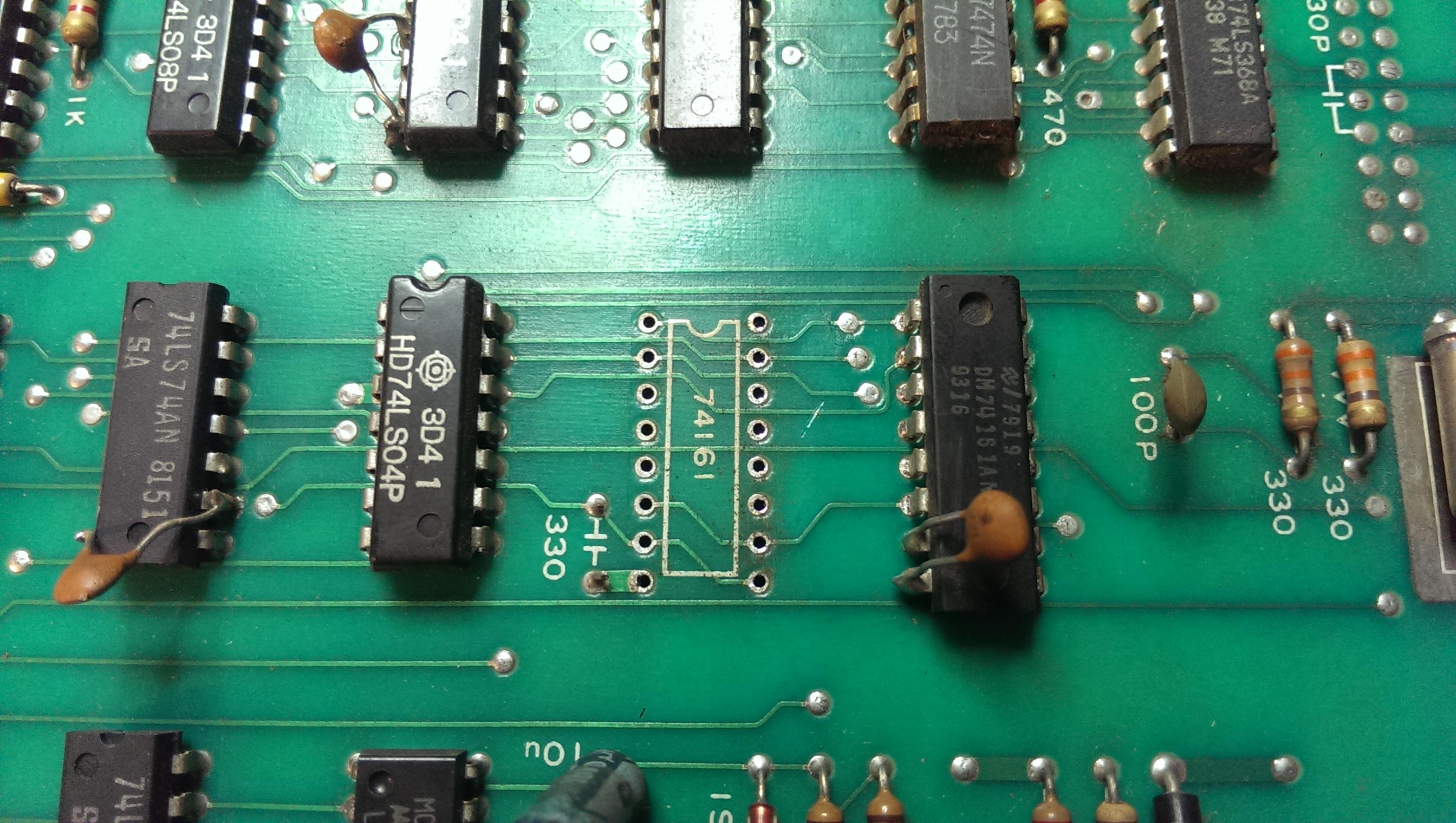
Using a logic probe I could see that the outputs of the 74LS161 @ H14 were all HIGH. As there is no clock present to this chip it should not have counted anything at this point and they should all be LOW. This meant to the board was booting up in an incorrect state and the clock circuit was never starting.
I desoldered and replaced the offending 161 chip.
IMAG0616

The clocks were now all present but I just got a static blue screen and the watchdog was constantly resetting the system.
Using my in circuit Arduino tester I knew the ROMs could all be read correctly by the CPU. I also knew all the program RAMs were fine.
Replacing the 6809 CPU allowed the game to boot properly.

Next problem was the sound or lack of it.
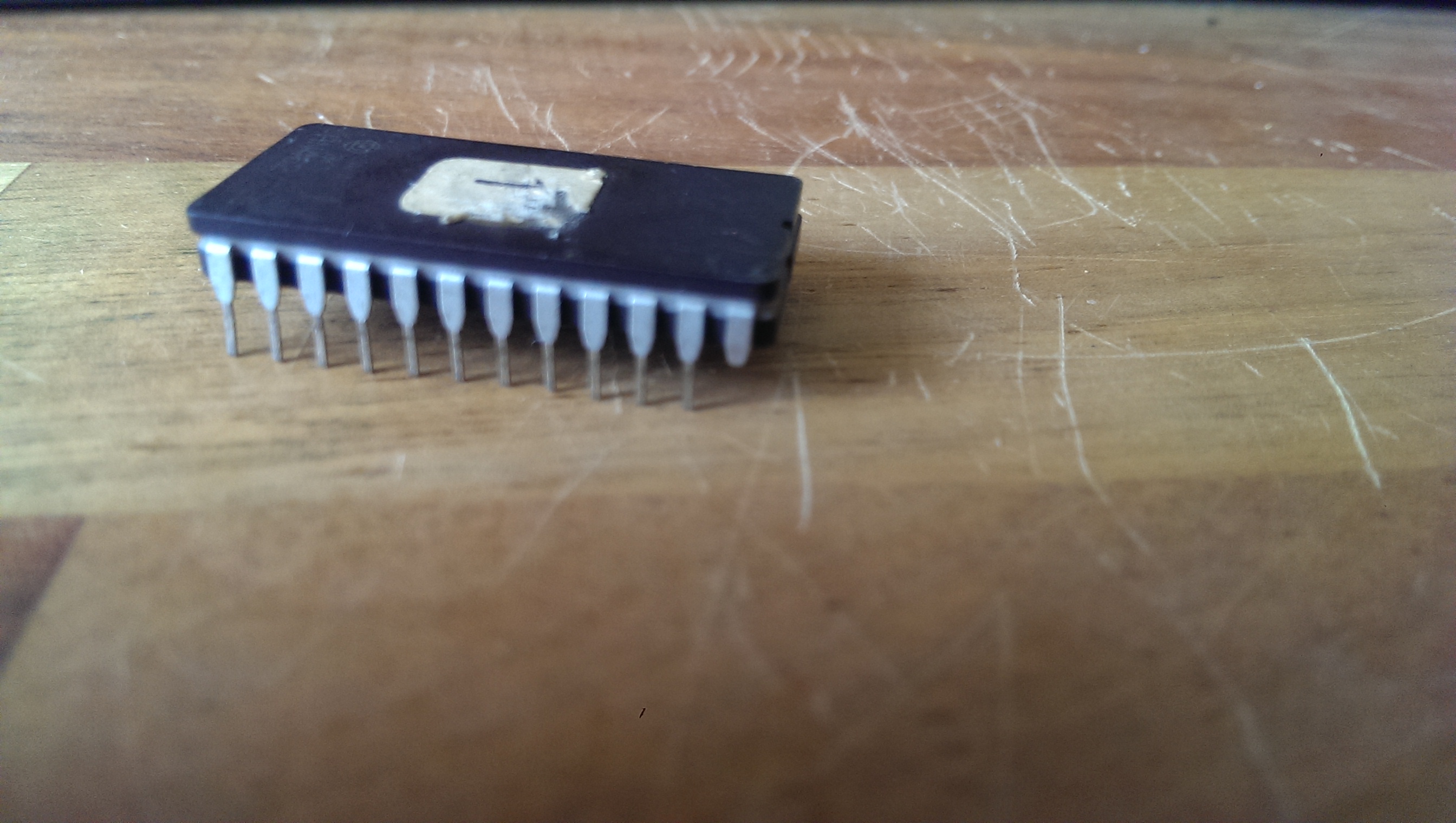
The sound CPU is a good old Z80 so I fitted the Fluke and did a ROM check. This reported back an incorrect signature and when I removed the ROM I see this
IMAG0618

The VCC pin was missing. I soldered a new pin onto this and this board is fully fixed.

The last bootleg board has been a major pain and at this point in time I have admitted defeat with it. I have also been harvesting parts from it to fix the others so it will be written off.

Fujitsu FM-TOWNS Marty PSU repair log

 Console Repair Logs, Repair Logs  Comments Off on Fujitsu FM-TOWNS Marty PSU repair log
Jun 172014
 

I got from a German customer this nice Fujitsu FM-TOWNS Marty console.

For the uninitiated FM-TOWNS Marty a Japanese console whose hardware is derived from its “big brother” FM-TOWNS computer.It has some of the coolest perfect arcade ports ever published like Splatterhouse, Bubble Bobble, The New Zealand Story, Tatsujin Oh and others.

As every Japanese device it has to be powered by 100V/110V so European people must use a step-down converter capable to reduce our 220V/240V to proper voltage .

This is what the owner of this console forgot to do by mistake..:)

So, after some seconds the “magic smoke” came out from the console.

Obviously the console did not power at all so i opened it and I immediately noticed some blown components.In particular the main 2A fuse was blown and a 100uF 200V capacitor was literally exploded on its top.The blown fuse was a good sign since it means he made his duty blocking the excessive current flowing in the circuit but the big 100uf 200V exploded capacitor meant  that this overcurrent reached also other components before the main fuse blown up.So, I decided to further investigate.Usually the first component after main fuse and filter capacitor is the bridge rectifier (which, indeed, rectifies the sinusoidal current in continuous one).In my case there was a 600V 1A bridge rectifier marked ‘S1WB S60’, here the datasheet:

S1WB Datasheet

Infact, as I suspected, I tested it with a multimeter and it was shorted.

So, I desoldered these three bad components:

and replaced them with equivalent ones:

Reassembled the console, powered it and got this:

Mission accomplished.

 Posted by at 8:08 pm

Juno First repair log #2

 PCB Repair Logs, Repair Logs  Comments Off on Juno First repair log #2
Jun 152014
 

So here is the second repair log.
Pretty simple this one but I never took any pictures of the actual fault so Ive taken a snapshot of the event in MAME to show it.

The game plays as normal but when the blue ball enemies spawn into the game the froze up on screen and did nothing as circled in red in the picture below.
juno2

On my visual inspection I noticed a 1K pull up resistor array next to the bank of 4116 RAM chips what cracked in half.
juno2-1

Replacing this fixed the fault.

I did initially think there was another fault as the ship movement in attract mode seemed a bit strange but after checking in MAME this is a characteristic of the non Gottlieb version. In the Gottlieb version this behavior is not present.

Martial Champion PAL dump added

 PAL Updates  Comments Off on Martial Champion PAL dump added
Jun 152014
 

Well, after one month of pause (real life like sucked me..) finally I’ve found a little bit of spare time to do some updates.

So, here is the PAL dump from an original Martial Champion PCB.I can’t test it since the PCB is faulty but there should not been any problem.Please, note that there is also another PAL on the PCB but it’s a 24 pin device (a PAL20L10) so out of my dumping abilities.ASAP I will send the chip to my colleague Porchy in order to dump it.

 Posted by at 4:19 pm

Konami 007644 custom chip

 General, Technical Info  Comments Off on Konami 007644 custom chip
Jun 132014
 

Ive got a board that needs a new 007644 custom chip.
While im waiting to find a new one I thought I would investigate how this chip actually works.

Pin 1 = SEL – changes whether the Q outputs require a rising edge clock or not.
Pin 2 = OEY – Output enable for the Y outputs else they are inputs. Active LOW
Pin 21 = OEQ – Output enable for the Q (clocked) outputs else they are inputs. Active LOW
Pin 12 = CLK – Clock input

Pins 3-10 = Y outputs – normal outputs. If OEY is LOW these pins become outputs mirroring the state of the Q input pins. SEL and CLK pins are not used in this mode.

Pins 13-20 = Q outputs – clocked outputs. If OEQ is LOW these pins become outputs. If SEL is HIGH and CLK is HIGH these outputs will mirror the state of the Y inputs. If SEL is LOW then the outputs will only change state on a rising edge CLK.

Pretty simple and should be easy to implement in a small CPLD if ever required (next project???)